Showing posts with label Theatre. Show all posts

Wednesday, April 4, 2018

DOUBT's Double Debuts: An Interview with Colleen Madden & Malkia Stampley

by Jarrod Langwinski

Both Colleen Madden and Malkia Stampley have extensive, enviable acting resumes. Colleen, based out of Madison, is a Core Company member at American Players Theatre, who's appeared at Forward Theater Company, Children's Theatre of Madison, Renaissance Theaterworks, the Milwaukee Rep and more. And Malkia is based right here in Milwaukee -- she's a graduate of Marquette, former Rep acting intern and former Skylight Resident Artist -- but has branched out beyond our stages to television, with credits on Shameless, Chicago PD, Empire and a recurring role on Showtime's The Chi.

But there's one place neither of them have ever performed - right here at Milwaukee Chamber Theatre!

DOUBT marks the first MCT show for both Colleen and Malkia, playing Sister Aloysius and Mrs. Muller, respectively. To mark the occasion, we asked them a few questions about their careers and their roles in the show.

Being someone who has performed on a variety of platforms and genres, what kind of characters have you enjoyed the most and what works are captivating you today?

Colleen: It’s always difficult to say what roles, or what kind of roles, are my favorites. Part of the joy of acting is getting to investigate such a variety of types of people. It’s a bit like my children; they’re all my favorites!
I tend to favor poetic plays, poetic in both language and physicality. In essence, theater that doesn’t translate to screen. Plays like THE BROTHERS SIZE, which I recently saw at MCT. It was a world of its own and made me feel I was watching language be reinvented. I do enjoy the occasional episodic, sitcom-structure play, though I suspect tv and film will always do that better.

Malkia: I find myself drawn to contemporary works that deal with current hot topics or any piece that I can parallel with issues in our community today. I strongly believe the theater has to stay relevant and fight continuously to be a part of the conversations happening around the country. I love musicals and started my career primarily singing and dancing in the American classics but I am so grateful that I have been able to find a balance.
I played Truly Scrumptious in CHITTY CHITTY BANG BANG at First Stage just a few months ago and shortly after was in a workshop for a play that focused on the Flint Water Crisis. The light-hearted, not-too-deep works remind me to laugh and the more heavy pieces remind me that our work as an artist can be a catalyst for political and social change.

What excites you the most about Milwaukee's theatre scene?

Colleen: That there is so much going on! And that the smaller or middle-sized theaters are doing really ambitious works, both contemporary and classic, and doing them exceptionally well! The theater scene here makes me want to move to Milwaukee.

Malkia: There has been a shift, a new consciousness in programming and inclusion in Milwaukee. Milwaukee theaters have a very long way to go in terms of diversity and inclusion but I see there are steps being taken and that does excite me! I also love that there is still room for growth in the theater community. Smaller theaters are increasing or maintaining their programming and larger theaters are finding new audiences. It's an exciting time. I love that the few artists of color in Milwaukee have more of a chance to work.

Malkia Stampley.
DOUBT takes place during a time of great change in our country's history; socially, politically, and in the realm of religion. How do you think it speaks to today's movements of change as well as feelings of uncertainty and what do you think contemporary audiences can learn from plays like DOUBT?

Colleen: I think it urges us not to flee from the gray areas just because we don’t completely understand. Great swaths of us are single issue voters, and refuse to take in all the complexities of an issue, at the cost of the two things that make us uniquely human: reason and compassion.

Malkia: DOUBT reminds us that one's platform or fight is not for everyone and we have to be okay with that. We do not know everyone's story or agenda. People have baggage and sometimes complex situations that make it difficult to march or support a particular cause, no matter how basic and right it appears to all of us.
I read about black teen activists who refused to march for the March of Our Lives. The platform is strong, the cause is rooted in the desire for unity and justice, but when you look at the complete lack of interest, support and coverage for teens of color who were often demonized for marching or speaking up by all kinds of people since the killing of Trayvon Martin or even since the crack epidemic in the 1980s, its difficult not to understand. People have called them stupid and believe they are missing an opportunity to shed a light on their causes, but I wonder if the black teen activists who refuse to participate see that the fight to protect their agenda is more important than rushing to pick up someone else's.

Colleen, you've been performing with American Players Theatre for 18 seasons. What's something valuable you've learned over that time that's helped you grow as an actor?

Colleen: That I’m only one part of the story. When we rehearse in that gray big open space at APT, in front of a thousand empty seats, we sometimes feel a little lost. When, finally, people arrive en masse and fill up those seats, we hit the groove. We need to give our play to an audience!

Malkia, having had success in Chicago, New York, and even while touring Japan, what has been one of the biggest lessons you've learned as an actor? And how has that helped you work on complex roles such as Mrs. Muller?

Malkia: One of the biggest lessons I have learned as an actor over the past few years is that I am human and most likely so is my character (though I have played a reindeer, dog, alien, etc.) It is very easy to be intimidated by a character and their complexities but letting that character live in me, not judging them and allowing them to be quirky like me, have the same fears and joys as I do, has helped me to appreciate their humanity. Another simple but eye-opening lesson has been the act of breathing and listening. We do it so well in real life! Nerves can shorten breath or keep you in your head, but when I focus on breathing and listening, my character is able to fully exist.

Milwaukee Chamber Theatre's 2017-2018 season is aptly titled, "The Mysteries of Life." How do you think shows such as Doubt, A Parable bring audiences and artists alike to better question or understand their own uncertainties?

Colleen: I really hope that when people leave their seats after seeing Doubt, they are still untangling what happened. That’s life!

Malkia: DOUBT is one of the few pieces that I can hear and watch over and over again. I think it's the trickery in Shanley's writing that forces me to check my judgement in others. There are times I find myself agreeing with one character one day and then disagreeing with them the next!
We are quick to put people in a box based on a feeling, the way they look or the interpretation of something you may have seen. Lingering in uncertainty is what people are afraid of. We rush to make quick decisions about people and situations and refuse to change our opinions. I sometimes can be slow to make a decision but I think it is based in the fear that once I do, I can't change my mind. We all judge or assume and okay, it is what it is, but I hope we learn to acknowledge when we may be wrong about someone or something.

What advice would you give young actors of today as they try to break into the ever-changing world of theatre?

Colleen: First of all, there is so much more to theater than acting! There is design, directing, dramaturgy, coaching, stage management! Go to see theater, as much as you can, and investigate what really turns you on. If it’s acting, study the performances and start to discern what helps the story and what doesn’t. Then audition for local productions. Finally, don’t stress about being nervous and clueless when you get on stage; we all feel that way! Breathe and be.

Malkia: I am a firm believer that whatever you dream long enough you can achieve. I would add to that placing yourself around the right people. For those who are new to a theater community, take an acting class (even if you already have your degree), volunteer to usher, reach out to casting directors of every theater, apply for any type of job (box office, reception). Shift your life to include the theater community you want to be a part of.
My biggest advice is to stay fluid, open, ready and willing to change. If you love the classics, great, but you limit yourself when you refuse to audition for that wacky, abstract new work. The biggest theaters in town may hire you, but for most of us in the local scene, the strongest and most consistent relationships will be with smaller theaters (where you really get to work your chops) and the artists who work in those smaller theaters so don't ever take that for granted - they will be your rock as you travel up the ladder of success and trust me, you will crave that foundation and friendship when it's time to celebrate every success.

Wednesday, January 31, 2018

Meet the brotherhood of THE BROTHERS SIZE!

The limits and boundaries of brotherly love are tested in the THE BROTHERS SIZE, a play by Terell Alvin McCraney. Combining West African myths with contemporary issues of post-prison life and the need for companionship, this story takes a look at brothers Ogun and Oshoosi Size, the former a mechanic with a strict, disciplined life, and the latter a recently released ex-con with a relaxed desire for a simple life. In the midst of their clashing ideologies and the looming of law enforcement arrives another inmate, Elegba, who was close with younger brother Oshoosi and has surprising aspirations of his own.

In a play where everyone wants their own form of freedom, they must first release their secrets. But what are these characters hiding? THE BROTHERS SIZE features four performers onstage, three of which are actors. Learn more about them below, and come see them in MCT’s Studio Theatre later this month! To buy tickets, visit our online box office or go to milwaukeechambertheatre.com!

MARQUES CAUSEY - Elegba

Marques Causey returns to Milwaukee Chamber Theatre after having last appeared in PICNIC. A Milwaukee native with a BFA from the University of Wisconsin-Milwaukee, Marques has worked with Renaissance Theaterworks (THE BALLAD OF EMMETT TILL, LUNA GALE); In Tandem Theatre (HOLIDAY HELL: THE CURSE OF PERRY WILLIAMS); Door Shakespeare (JULIUS CAESAR, A MIDSUMMER NIGHT’S DREAM); Children’s Theater of Madison (TO THE PROMISED LAND) and Forward Theater Company (THE FLICK, EXIT STRATEGY), among others. Later this season, he will appear in ANTARCTICA, WI at First Stage.

As Elegba, an ex-con and close prison mate of Oshoosi, Marques will be playing an unorthodox man who has a sincere and empathetic influence towards the younger brother Oshoosi. His impression on the older brother Ogun, however, is one of caution. Elegba’s needs aren’t always as clear as the other characters, but his impact is immense.

TRAVIS A. KNIGHT – Ogun Size

Travis A. Knight is happy to be back at Milwaukee Chamber Theatre. His previous MCT credits include WELL and MOON OVER THE BREWERY. Most recently, he appeared as John Proctor in THE CRUCIBLE at Steppenwolf Theatre. Other Chicago credits include AH, WILDERNESS!, A CHRISTMAS CAROL, THE SIGN IN SIDNEY BRUSTEIN’S WINDOW, MEASURE FOR MEASURE, and CAMINO REAL (Goodman Theatre); and CAMELOT (Drury Lane). Other regional credits include: VANYA AND SONIA AND MASHA AND SPIKE (Forward Theatre Company); THE GIRL IN THE FRAME, JESUS CHRIST SUPERSTAR (In Tandem Theatre); THE PERSIANS (Renaissance Theaterworks); and HOODOO LOVE, A STREETCAR NAMED DESIRE (Uprooted Theatre). He has also spent five seasons with American Players Theatre appearing in THE TWO GENTLEMEN OF VERONA, RICHARD III, THE GLASS MENAGERIE, TROILUS AND CRESSIDA, and THE TEMPEST. TV credits: Chicago PD, Chicago Fire, Chicago Med, and Mind Games. Film Credits: Henry Gamble’s Birthday Party and Runner.

As Ogun Size, the hardworking auto mechanic and older brother of Oshoosi, Travis portrays a life-hardened man who has to walk the line between protecting his brother and living for himself. His tactics are as honest as they are fearful, and when Elegba enters their life he finds himself in an even tougher predicament.

ANDREW MUWONGE – Oshoosi Size

Andrew Muwonge is honored to be making his Milwaukee Chamber Theatre debut. Other credits include: UNSILENT NIGHT and TWILIGHT: LOS ANGELES, 1992 (Next Act Theatre); FREEDOM HIGH (Uprooted Theatre); A SWELL IN THE GROUND (The Gift Theatre); LETTERS HOME (Griffin Theatre); DON'T GO GENTLE (Haven Theatre); OTHELLO: THE REMIX u/s (Chicago Shakespeare Theatre); CITY OF CONVERSATION u/s (Northlight Theatre); THE LAST CADILLAC (American Demigods); PEACEBOOK (Collaboraction Theatre); FREEDOM CODE (Greatworks Theatre); and UNITED FLIGHT 232 staged reading (The House Theatre of Chicago). Andrew received a BFA in Theatre-Performance from the University of Wisconsin-Whitewater and is represented by Stewart Talent.

As Oshoosi Size, the younger brother to Ogun, Andrew portrays a recently released ex con who would rather live a laid-back and relaxed lifestyle than go back to work. For Oshoosi, freedom is everything, with desires for a car, a nice woman, and a new land to roam. When Elegba returns and offers Oshoosi those opportunities, he must decide between his own brother’s loving protection and Elegba’s mysterious generosity.

JAHMÉS TONY FINLAYSON – Percussionist/Narrator

Jahmés Tony Finlayson is an accomplished musician, performing artist, storyteller, composer and workshop facilitator. His interactive and engaging presentations include music, songs, stories and movement of Africa, the Caribbean, the Americas and beyond. Jahmés also conducts classroom sessions and workshops including those on peacemaking, creativity, creative use of found objects, instrument making, drumcraft and circlework. He leads drumming and music workshops for people of all ages and cultures and is the Musical Director of “Children of the Sun,” a drum ensemble for deaf and hard of hearing youth at the Wisconsin Conservatory of Music, where he is a faculty member. “Jahmbo” is also a Music and Multi-Arts Specialist with Express Yourself Milwaukee Inc., and performs regularly for Panadanza, Music of the African Diaspora Ensemble, Milwaukee Public Theatre, Dance Circus/Youth Dance Co. He has a long standing affiliation with the world renowned Ko-Thi African Dance Company as a poet, musician and prop designer. Jahmes is First Contact and a core member of the popular Milwaukee based world music group, “One Drum.”

As the percussionist and musical "narrator" for the show, Jahmés will tell the story alongside the actors exclusively through his rhythms. All of his percussion will be performed on found objects, to further integrate him into the scenic environment.

Tuesday, July 25, 2017

Violence by Design: An Interview with Fight Director Christopher Elst

by Marcella Kearns

A few summers ago, I saw a sequence of torture and murder onstage that horrified me in all the right ways—simply, it looked real. Fully immersed in the tension of the moment, I forgot for a moment where I was. In hindsight, however, I realized I hadn’t for an instant worried about the actors both perpetrating and undergoing the crime not ten feet from me in real time. Why?

Christopher Elst.

Elst, fight director for MCT’s production of DEATHTRAP, has a gift for making an audience squirm with the kind of intricate physical storytelling that follows when conflict between characters escalates beyond words alone. Since seeing his work for the first time those summers ago, I’ve been insatiably curious about his process and his own story. Recently, even as he wrapped Theater RED’s latest production (Elst and spouse Marcee Doherty-Elst are the company’s producing directors), he graciously granted a request for an interview.

Marcella Kearns: What originally drew you to undertaking the study of violence design (stage combat)? What continues to captivate you about this aspect of the theatre?

Christopher Elst: I started in high school when I heard about the “fencing” program for the high school Madrigal Dinner in Kenosha. I had always had an eye for swords and martial arts and thought this might be a way to start learning more. I was “captain” of the team in my senior year, but it was really more of an acting troupe than anything. I began to assist the teachers in my first year out of high school, and then began teaching it myself shortly thereafter. I joined the SAFD (Society of American Fight Directors), at the urging of Jamie Cheatham, in 2006 and have pursued stage combat as a profession ever since.

MK: Tell us about your personal process in building physical fights onstage. How do you approach a script and your work in the rehearsal hall?

CE: Theatrical violence incorporates the most important aspects of theatrical performance: objectives and commitment at the very highest stakes, physical communication and cooperation between actors, and a dual awareness at both the character and actor levels. For me, stage combat informs all of my work as an actor.

I consider stage combat to be a modern martial art, focused on storytelling, rather than defense, in the same way that many Eastern disciplines teach that violence and destruction are set aside in favor of aesthetic creation. A master becomes an artist, as the understanding of violence reminds one of their human nature—the earth, the id, the beast, etc.—but channeling that directionless passion are the creative and rational drives. As artists in the theatre, the consummation of all arts, we have the ability and responsibility to bring this violence as realistically to bear as we are able in order to confront and discuss, and perhaps to change, the way in which we accept and cope with our natural tendency toward violence.

To that end, it is essential that we as fight directors give our actors the tools required to tell these stories. By necessity, we begin to help with precautions against harm; beyond the obvious preservation of the body, if the actor must hesitate because of a safety concern, then we have hindered the story by whatever fraction that hesitation costs. Contrarily, when we instill in actors the knowledge and practice to free them of the constraint of fear, we not only allow that particular scene to come alive, but we bring the actors to a greater state of awareness and commitment, which can only serve them in all aspects of performance.

The responsibility is colossal for fight directors, as with any teachers, to keep this always in mind. We must understand fear, violence, and all of the darkest parts of our humanity in order to create compelling art, but we must be in command of those forces, and teach others to be in command of them, if that art is to be of value.

Elst directed the fight scenes in Theater RED's swashbuckling BONNY ANNE BONNY.
(L, Zach Thomas Woods; R, Alicia Rice. Photo: Traveling Lemur Productions)

MK: What have you found is the most challenging part of staging fights with actors who have very little experience with combat? What’s challenging, on the other hand, about working with actors who are very experienced?

CE: Classical acting training once mandated that all actors be trained in stage combat, but it’s rare to run across someone with more than cursory knowledge today, which is surprising when one considers all of the popular media that features violence. Working with an actor unfamiliar mostly poses challenges in getting the appropriate commitment level; they are usually either too timid or too eager. I am fond of saying, “Keep your method acting out of my stage combat, please.”

Contrarily, with actors accustomed to the work, including me, the trick is to remind them of the dangers the characters face and not to be too complacent in the responses. Also, veteran stage combatants can cling to bad habits, or make a character seem facile with a weapon, when the character should not be. Being too comfortable with stage violence can be detrimental to the story, even if safety is more assured.

MK: There are several weapons revealed as part of the setting of DEATHTRAP. If you had your pick, which of those would be most exciting to you to use in a fight and why?

CE: I have to say, I was drawn to the work by swords, and I’m still fascinated by them, even with my facility in their use. There’s a reason other weapons just never found their way as strongly into the canon of theatrical violence, and indeed, history. There have always been swords. Their elegance and effectiveness are unsurpassed.

MK: Along the same lines, what do you enjoy most about DEATHTRAP, both as an artist working on the team and as one who gets to see it from the house?

CE: Long before I considered the theatre as an occupation, I had seen the film version of DEATHTRAP. I love the blend of dark humor and true thrills, and I hope to bring the actors to a place where they can startle even me with this production.

MK: If it’s possible to answer this without spoilers: what do you foresee may be the most challenging thing for you to accomplish (and/or the actors to execute… no pun intended…) on DEATHTRAP?

CE: Theatrical violence is no different than a magic trick. The challenge here is that we never know which effect is meant to be real and which is a character fooling another character and the audience. We want to create that duplicity without belying the truth of each moment. That will take some real focus, and I think we have a great team to make it happen.

MK: Do you have any “dream plays” to choreograph?

CE: I think I’d like to have a chance at THE THREE MUSKETEERS or something in that vein. BONNY ANNE BONNY (with Theater RED) was the closest I’ve come, and we did a bang-up job if I say so myself, but those old swashbuckling epics were the beacon to me in my youth, and I’d like to see what I can do when realism is no limit.

Elst’s innovation seems to have no limit. Join us at MCT for DEATHTRAP — with him in charge of the fights, we can guarantee the thrills.

DEATHTRAP opens August 10 and runs through August 27. Tickets can be purchased at 414.291.7800 or online.


Tuesday, January 24, 2017

American Misfits

by John M. Baker

Playwright Sam Hunter
Photo: John D. and Catherine T. MacArthur Foundation
Sam Hunter’s plays take us down roads not frequently traveled on the American stage. Anchored in small towns and cities throughout the landlocked state of Idaho, the plays are often set in unglamorous locations and populated by characters on the margins of society. From the tarnished evangelical in A BRIGHT NEW BOISE seeking employment at a Hobby Lobby craft store to the 600-pound online teacher in THE WHALE eating himself to death in his apartment, Hunter's characters find themselves in simultaneously ordinary and extraordinary circumstances, navigating big questions of modern life. With his growing body of work, Hunter is slowly mapping what he calls “a quotidian America that is often hidden behind curtains and doors.” In the process, he’s capturing the beauty and ugliness, the fragility and ruggedness, the banality and spirituality of living in America in the 21st century. 

Though New York City is Hunter’s home now, his roots are firmly planted in Idaho. Born and raised in the state’s panhandle, Hunter can trace his family’s lineage back six generations to the region’s first homesteaders. This deep-seated connection to the Northwest — like Horton Foote and the South — is only part of why Hunter frequently sets his plays in his home state. “Idaho has become a useful landscape,” he explains, “because people don’t have a lot of preconceived notions about it.” You’ve probably never set foot in the towns of Hunter’s plays, but there’s still something recognizable about the employee lounge in A BRIGHT NEW BOISE, the one-bedroom apartment in THE WHALE, and the lobby of the assisted living home in REST. “Which is really helpful,” he continues, “because it allows me to make something pan-American.” 


Morbidly obese writing instructor Charlie (Matthew Arkin) and his friend and caretaker Liz (Blake Lindsley) share a moment in this image from South Coast Repertory's West Coast premiere of THE WHALE (2013). Photo: Scott Brinegar.
Within these familiar and foreign landscapes, Hunter places characters from a particular walk of life. They’re Middle Americans: big-box store employees, nurses, a retired music professor, a former night watchman, a missionary. “I think the prevalence of upper middle class and upper class characters in our plays is surprising,” explains Hunter, “especially given the fact that the majority of America is not these people.” More specifically, Hunter is fascinated by the people living on the fringes of acceptability in these small towns. “The stories my dad told me about people from his hometown were just incredible,” he explained to David Rooney of The New York Times. “Like the guy who used to go to my grandpa’s grocery store: My dad had to deliver food to him, and his house was full of dead cats. You hear about somebody like that, and you think, ‘What is the story of that person?’” 

While a closeted gay teen in northern Idaho, Hunter attended a fundamentalist Christian high school and worked part-time at the local Walmart, which informs why so many of his plays center on characters living in quiet desperation, hungering for something greater. “Most of my plays are about seeking hope and meaning,” says Hunter, “and religion is the eternal well of hope and meaning for most Americans. It so shaped my childhood growing up in Idaho and going to a religious school, and so I see it in the larger cultural dialogue a lot. Mostly I write about it because people don't seem to want to talk about it.” Even when nonbelievers populate the plays, they still “point to the divine,” as Hunter says, whether it’s by way of Melville in THE WHALE or Estonian composer Arvo Pärt in REST. 


Rattlestick Playwrights Theatre pitted actors Michael Laurence and Tasha Lawrence against each other as former lovers Bryan and QZ in its Off-Broadway premiere of THE FEW (2014). Photo: Joan Marcus.
“Hunter’s characters live in an Idaho where the divine smacks up against the banal, where their expansive worldviews create a profound disconnection to their quotidian surroundings,” writes Adam Greenfield, director of new play development at NYC’s Playwrights Horizons. “They’re as lost within Idaho’s suburban sprawl as they are within the cosmos, each one struggling with a fundamental part of his or her self — whether it’s religion, sexuality, ethics, or a cocktail of all these things — that doesn’t fit into their surroundings or daily lives.” 

American culture is certainly a part of the topography Hunter is mapping, but he’s not writing “issue” plays. Although he weaves topics like obesity, the Rapture, and gay conversion therapy into his scripts, as literary manager Douglas Langworthy of The Denver Center Theatre Company puts it, “they are never about these issues.” Rather, at the forefront of Hunter’s plays are his emotional and spiritual misfits — drawn with sensitivity — mirroring back to us their experience of Middle America today.  


John M. Baker is a dramaturg and the Artistic Leadership Fellow at The Lark, an international theatre laboratory based in New York. He is also the associate producer of Partial Comfort Productions in NYC, interim literary manager and dramaturg at Long Wharf Theatre and has formerly worked at the Williamstown Theatre Festival and Woolly Mammoth Theatre Company. Versions of this article originally appeared in playbills for productions of REST at South Coast Repertory and Victory Gardens.

Monday, November 7, 2016

Heroes in Search of a Code

by Deanie Vallone

Think of the word “hero” and what is conjured? Marvel superheroes? Historical movers and shakers? Fanciful characters from literary epics? Regardless, heroism usually requires one to shed the weight of humanity, excel above and beyond the ordinary citizen to make a lasting, positive impact on the world.

The characters in Kenneth Lonergan’s play, LOBBY HERO, do nothing of the sort. And yet, as the story unfolds, these four characters — an ensemble, each protagonists in their own right — find themselves touching the shiny veneer of the word “hero” and grappling with its meanings and implications.

Chris Klopatek plays Jeff in MCT's production
of LOBBY HERO. Photo: John Neinhuis. 
When we open on the titular character of the play — lobby security guard, Jeff, a wise-cracking man-child with no sense of decorum or filter — it is difficult to see how he could be labeled a hero, even if only a “lobby hero.” With the appearance of the play’s three other characters — by-the-books supervisor, William; on-the-rise cop, Bill; and his on-probation rookie, Dawn — the question of heroism becomes inextricably linked with modes of power and performance. 

Though there is clearly a hierarchy, in which Jeff occupies the bottom rung, and the cops see the security guards as “doormen,” all four characters, by the virtue of their work as protectors, grapple with the complexities of power, authority, and the law. But Lonergan’s skill with LOBBY HERO is extrapolating the reality of their humanness, the painful limitations that restrict these potential heroes not necessarily physically, but morally and ethically.

Morality is understanding the distinction between right and wrong, while ethics is the philosophy of how that morality shapes and guides individual and group behavior. While some critics have called LOBBY HERO a melodrama — what with its murder investigation and sexual politics — Lonergan says the play is “a bit like a fable, a tangled morality play.”[1] Like his previous plays, THIS IS OUR YOUTH (1996) and THE WAVERLEY GALLERY (2000), he infuses LOBBY HERO with naturalism, but this play distinguishes itself with “something more theatrical, […] a bit more heightened.”[2] It is clear from the beginning that all four characters are playing at heroism—Bill as the “Supercop;” Dawn, whose brash attack on a civilian is just one act of many meant to prove her worth in the police force; William, struggling to run a smooth ship, despite personal and professional obstacles; and Jeff, who, despite his goofball personality, is sincere in his desire to be a better version of himself. 

This concept of performance is key because when faced head-on with issues of morality and ethics, these characters become embroiled in “a restless search for a new moral code in response to the failure of the old codes.”[3] In searching for this new moral code, they must be the ones to define it.

Lonergan’s quartet occupies a gray area — in their struggle for goodness, they make plenty of mistakes. At odds with themselves, these are people who see and appreciate heroism, but lack the ability to achieve it. Jeff encapsulates this perfectly when recalling his Naval officer father’s own heroic actions. “It’s actually a really amazing story,” Jeff begins. After listening to how Jeff’s father saved the lives of twenty-three of his fellow Naval men, William remarks, “That’s very impressive,” to which Jeff replies, “Yeah: I know it is impressive.” With a childhood marked by his father’s re-performing of heroism through the act of storytelling, Jeff’s own retelling of the event is imbibed with awe and a deep-seated animosity for a heroism he longs for but struggles to emulate.

Lonergan’s characters tap into the “theatricality” of heroism, if not the actuality of it. For a play about murder, blackmail, and sexual harassment, LOBBY HERO lacks a police drama’s heightened action. Instead, the play encloses the characters in an environmental crucible — a high-rise lobby in Manhattan — where they perform heroism through the myth-building act of conversation and storytelling. We rarely see physical action being taken; instead, we listen to the characters attempt to shape and define their personal narratives, and thus themselves, through the versions of the stories they tell.

"I was interested in people’s personal behavior versus what they expect of themselves,” Lonergan says of this play.[4] This conflict of interior and exterior selves, of expectation and reality, is key to the characters’ interactions with each other. Dawn, for example, plays tough around other cops — ”You make them respect you” — but her partner still sees her as “a little girl wearin’ a police uniform.” William and Jeff argue about responsibility to one’s family while Dawn argues for lawfulness. “[I]t’s still your responsibility to tell the truth and obey the law. You can’t just make it up when there’s some part of it that you don’t like,” she says, to which Jeff counters, “But somebody made up the law, didn’t they? Some people made up the law, a bunch of people like you and me literally sat down and wrote it up[...]” Jeff’s statement notes the inherent myth-building within the old moral codes, inherently flawed because they were created by people. 

Lonergan has mentioned that many characters in his plays are based on real people. The reality of humanness at work here remains central to the characters’ moral and ethical struggle to define themselves and the world around them. Unable to shake their humanity, their quest for heroism is weighed down with real flaws, moral quandaries, biases, and fears.

The world of LOBBY HERO is morally muddy. It’s not surprising then that Lonergan’s characters have difficulty navigating this quagmire, and don’t always come out with the correct answer. The play asks a lot of tough questions of its “heroes” and audiences: What does it mean if you’re doing the wrong thing for the right reasons? What if doing the right thing means hurting or betraying someone? When are we allowed to decide if the law is right or wrong? Are you still a hero if no else else thinks you are or if you’re maligned for your actions? 

While the play doesn’t easily answer all of the questions, heroism, it seems to say, does not come as simply as donning a cape.


[1]    Kushner, Rachel. “Interview with Kenneth Lonergan,” BOMB Magazine, 2001.
[2]    Ibid.
[3]    Siegel, Ed. “You can count on 'Lobby Hero' for craft, cleverness,” Boston Globe, 2001.
[4]    Renner, Pamela. “Talking Shop (Which Takes In the World),” New York Times, 2001. 

Tuesday, September 20, 2016

Daydreaming Within Reason: A Lesson from Tennesee Williams

by Logan Peaslee, marketing and development assistant

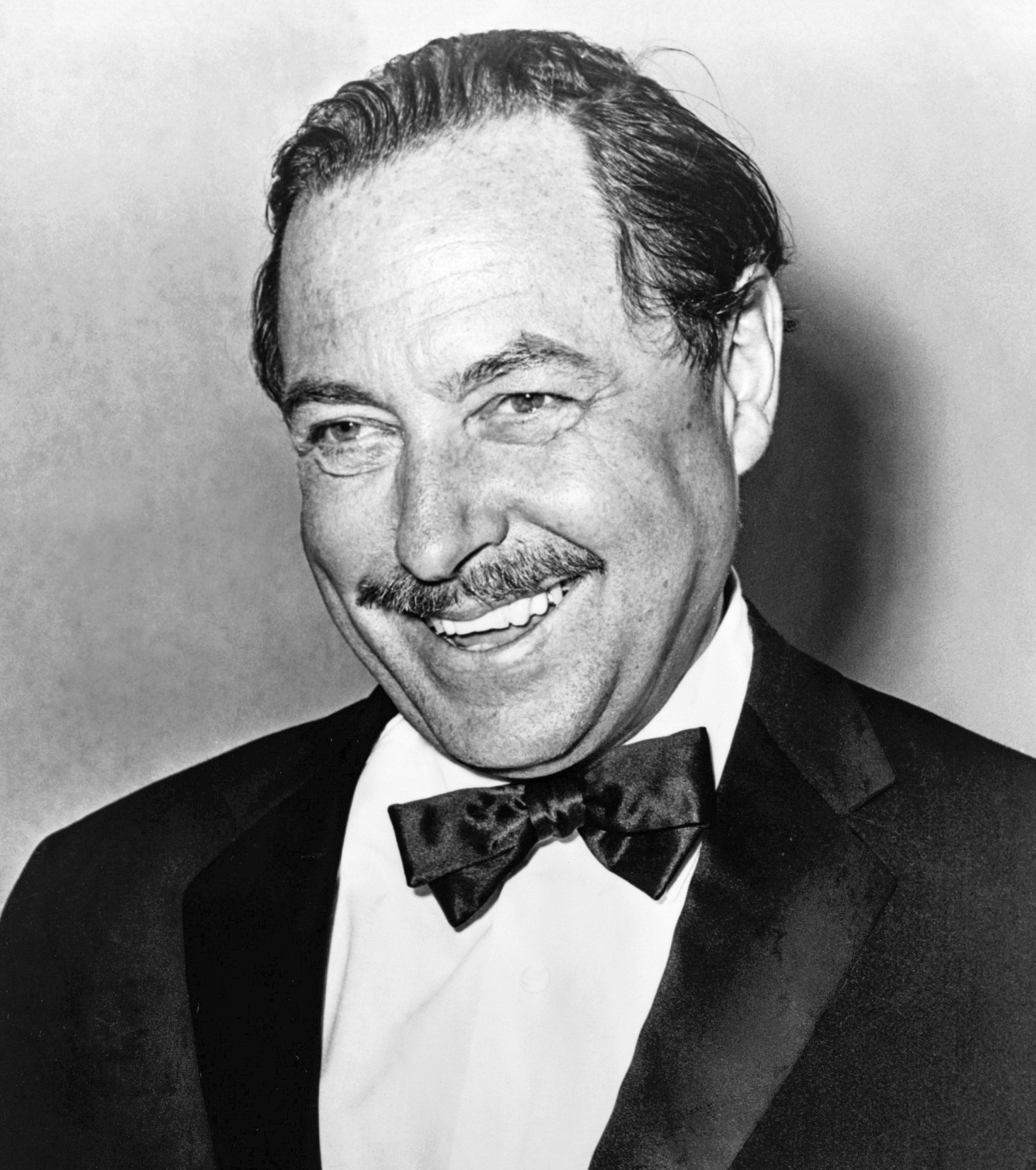
“One wakes up in the morning and reaches for eyeglasses, coffee, and a myth. You can see that one needs vision, energy, and that myth. Otherwise, the day is simply impossible to face, endure, survive.” –Tennessee Williams

Tennessee Williams, photographed in 1965, about
10 years before he wrote CREVE COEUR.
Photo: Wikimedia Commons.
But what is the myth that Williams believes we reach for in the morning? The answer lies in his play, A LOVELY SUNDAY FOR CREVE COEUR, which follows a group of women as they hope their way through a Sunday. Dorothea, a 30-something schoolteacher, hopes for love. Bodey, her kind-hearted German roommate, hopes to pair Dorothea with Bodey’s twin brother. Helena, the local art teacher, hopes to feign class. And Miss Gluck, Dorothea and Bodey’s neighbor, hopes to survive the loss of her mother. 

Bodey reaches for the myth that her twin brother, Buddy, and Dorothea should be together. Bodey believes that, if Dorothea were to focus her attention on Buddy, she could see Buddy romantically. In turn, Bodey reaches for the myth that two people can be meant for each other and that she is capable of recognizing and facilitating that.

Helena reaches for the myth that one’s success is reflected in one’s wealth. More specifically, she believes that she can elevate herself socially by securing nicer housing. The myth that Helena reaches for is not an uncommon one; people often occupy their presents by working towards obtaining things, material things that they think will bring them mental ease.

Dorothea reaches for the myth that what she feels for her principal, Ralph Ellis, is love. Dorothea mistakes her admiration of Ralph Ellis’ class for adoration of Ralph Ellis as a person. She also perceives her sexual encounter with him as proof of his commitment to her. Believing there is a mutual commitment between herself and someone she adores, Dorothea—and, consequently, the audience—assumes she is in love. But if her hope goes unfulfilled, can the audience assume she is experiencing true heartbreak? Or is Dorothea just experiencing disappointment and loneliness as she hopes? 

One character is without a doubt experiencing true heartbreak—Miss Gluck. Miss Gluck is being torn apart by the loss of her mother, yet her heartbreak is on the periphery of the play, emerging only as a comical inconvenience. With this structure, Williams criticizes people’s tendency to name disappointment heartbreak and shows that doing so discredits a supremely real and supremely difficult experience. It’s much like people who are late to eat their lunch describing themselves as starving. Frustratingly, Dorothea even equates her situation to Miss Gluck’s when she says, “Now Miss Gluck, now Sophie, we must pull ourselves together and go on.” 

Moreover, this play serves to criticize how personal myths, like Dorothea’s “romantic illusions” (as Helena describes them), can waste a day; they can waste a lovely Sunday. Williams implies that relying on unfounded hope and waiting for unpromised outcomes may tend to lead to disappointment, disappointment that may be falsely named heartbreak. Myths can plunder the present. But he also claims that myths help us face, endure, and survive the day. Williams would likely suggest that we daydream within reason.

The myth we reach for is that one’s life—its possibilities and its experiences and its relationships—is more magical, more romantic than it is. Life is beautiful and heartbreaking, absolutely. It’s just beautiful and heartbreaking less often than in our daydreams. Some days are nothing more than a lovely Sunday for a picnic in a park.

Milwaukee Chamber Theatre's production of A LOVELY SUNDAY FOR CREVE COEUR runs Sept. 21 to Oct. 16 at the Broadway Theatre Center's Studio Theatre, 158 N. Broadway. Click here for tickets or call 414.291.7800.

References
Grissom, James. Follies of God: Tennessee Williams and the Women of the Fog. New York, NY: Knopf, 2015.

Thursday, March 28, 2013

Carrying On: Why Wodehouse Sticks

by Marcella Kearns, MCT Guest Educator

Recently, on a whim, I asked a fellow coffee shop patron if he knew anything about P.G. Wodehouse.  I was beginning research for JEEVES IN BLOOM, Margaret Raether's second adaptation of Wodehouse's Jeeves stories, and we were in a chatty space.  He shook his head.

kearns"British writer?" I prompted.
"Oh, yeah.  Winnie the Pooh…?"
"Jeeves."
"Oh.  Oh, yeah!  Ask Jeeves!  On the internet.  The search engine.  Not around anymore, though."
"Yes, in a way."  (It's been shortened to "Ask.com.")
"Jeeves.  He was a butler, right?"
"Not exactly, no-"
Then it hit.
"He knew everything."
"Yes," I said.  "Yes.  He knew everything."

He knew everything. That someone to whom Sir Pelham Grenville Wodehouse himself was unfamiliar could nevertheless nail the defining feature of one of his creations tickled me.  Nearly a century after Wodehouse's beloved characters Bertie Wooster and his valet, Jeeves, appeared in print for the first time, this master-servant pair continues to find new life and loving audiences in all media.  Short stories and novels remain in print around the world.  Jeeves and Wooster stories have been adapted into films, television series, and plays over the course of several decades.  For those who don't know the man, Wodehouse's work, at least, continues to occupy a place in Stateside pop culture.  What about his stories sticks for us?  What, exactly, is the appeal, a century after he was coming into his own as a writer?

Craft and Style


Wodehouse had a keen instinct for the theatrical in both plot and word, and it's from that point that I launched a search which would take me through biographies, several Jeeves collections, and delightful conversations with playwright Margaret Raether and actress Karen Estrada.

WodehouseBy the mid-1920s, Wodehouse was established on both sides of the Atlantic as England's premier comic writer.  While he often gravitated to the short story, he was no stranger to writing for the theatre.  In the later teens, in fact, he began to collaborate with Guy Bolton and Jerome Kern, among other greats of the early 20th-century American musical theatre, to serve as lyricist and co-librettist on Broadway projects.  The team of Bolton, Kern, and Wodehouse served to set a new standard for the seamless integration of lyrics, music, and book into a cohesive story-something musicals hadn't heretofore made much of a priority.  Essentially, they helped mature the form.

Wodehouse credited the stage with helping him hone his own craft in prose: "I've found that writing musical comedy has taught me a lot," he wrote to his friend Bill Townend.  "In musical comedy you gain so tremendously in Act One if you can give your principal characters a dramatic entrance instead of just walking them on."1

RaetherEven as Raether attests that plotting is the most difficult part of her playwriting process, she praises Wodehouse for his ability to craft an airtight, improbable sequence of events and seeks to nail that spirit of screwball comedy in her own work.  "My favorite word to write is 'pandemonium,'" she shares.  "It's in all of my scripts.  It's good to be on hand for the first production because then I can help work out what happens.  'What do you want here?' I'm asked.  'Pandemonium!' I say."

Wodehouse's writing style seems as effortless in its complexity as his plotting.  His work is peppered with allusions to literature, the quirkiest of images, unabashed Edwardian slang, and sentence construction that gives any actor a breath-support workout.  Karen Estrada, who will play the socialite Madeline Bassett in JEEVES IN BLOOM at MCT, rhapsodizes about the richness of Wodehouse's text: "I love the 'Britishness' of it: the slang 'eggs and b' instead of eggs and bacon, for instance.  He writes lyrics and poetry, prides himself on G & S turns of phrase and cleverness."  Raether echoes the praise, pinpointing what for her draws us to the language: "It's a fabulous combination of silly funny and smart funny.  Wodehouse's wordplay is brilliant.  And we get the benefit of both.  Even as we laugh at the joke, we pat ourselves on the back for getting it."

Escape


Neatly plotted comedy and sharp prose aside, Wodehouse's work is Exhibit A in the argument for flat-out escape as a major benefit of fiction.  As common a purpose for entertainment as it is, the balm of escape is often unacknowledged.  Wodehouse's world purposefully keeps the worst of reality at bay.  Many of his stories sit squarely in an idyllic pre-war Edwardian England in which social struggles are distant, if not invisible.  In a BBC broadcast honoring Wodehouse in 1961, Evelyn Waugh likened Wodehouse's world to Eden.  Biographer Robert McCrum quotes the novel Something Fresh as insight into Wodehouse's intentional removal from the cares of the world: "Other people worried about all sorts of things-strikes, wars, suffragettes, diminishing birth-rates, the growing materialism of the age, and a score of similar subjects.  Worrying, indeed, seemed to be the twentieth century's specialty.  Lord Emsworth never worried."2

estradaEstrada and Raether both reflect on that delicious retreat-the safety and dazzle of Wodehouse's fictional England-when I speak with them.  "It was such a strange time," laughs Estrada.  "They had money and nothing to do, so they could collect weird things and have bizarre passions and pursuits.  What does Madeline do?  Nothing."  The worst of Madeline's travails are in firming up to whom she's engaged.  Raether muses, "I've always been fascinated by the fact that during a tremendous depression-people didn't resent movies about this kind of thing.  They didn't want to burn down the cinema.  For them, it was fun to visit a world where everyone wears those divine gowns to dinner."  Her reflection takes the analysis one step further.  "Perhaps it isn't just the clothes or the social status.  In fact, there is perhaps something satisfying about the fabulously wealthy getting into a tizzy, into fabulously ridiculous predicaments."

Did this ideal world, this attractive place to escape, ever exist?  Herbert Warren Wind recalls a gathering of Wodehouse and friends at the Patio, a restaurant in Westhampton Beach, in the early 1970s.  As a friend asked Wodehouse that very question, the writer, then a long-term exile from England, replied.

Oh, it very definitely existed.  When I was living in London around the turn of the century, a good many of the young men dressed in morning coats, toppers, and spats-or spatterdashes, to give them their full name.  I wore them myself when I paid afternoon calls.  I don't know why spats went out of favor.  They were very comfortable, you know.  Awfully warm.  Anyway, when I started writing my stories, Bertie was a recognizable type.  All the rich young men had valets.  Funny how fast a type disappears!  After the war, there wasn't nearly so much money around, so the young men had to go out and find jobs, and this sort of pulled the rug out from under a whole way of life.3

With the rug pulled out from a "whole way of life," Wodehouse provided-still provides-a haven.  He wrote to Townend, "There is the problem of whether to ignore the upheaval in English life and go on doing Blandings Castle and Jeeves stuff or try to do something modern… I believe people having a rotten time in England like reading of the days when there were butlers and so on."4 Certainly, what sold was escape-what audiences craved and needed given their own circumstances.

Reliability


Providing what was needed: that thought led me back to Bertie and Jeeves themselves, characters recognizable even to the unindoctrinated, and the question of their enduring appeal.  Estrada discusses the characters as warmly as though she's discussing old friends:  "Bertie is absolutely aware of his own stupidity most of the time.  How he relies on Jeeves!  We never hear anything from Jeeves' point of view [Bertie narrates the fiction], but we can tell how he has made the entire arc of the story work for himself."  Raether puts it another way: "In his own aristocratic way, Jeeves has fun.  Bertie offers more scope for his talents than anyone less talented at getting himself into difficulties."  Indeed, Jeeves' ability to plot a path that will extricate Bertie and neutralize a conflict with the best possible outcome for all players (including himself) appears superhuman, his knowledge and observation omniscient.  We, as audience, can't help but wonder how much of a kick he gets out of it.

Jeeves isn't alone in his reliability, however.  Bertie Wooster adheres to a strict personal code-never let a friend down-that invariably costs him sleep, time, reputation, and money (fortunately, the latter is in ready enough supply).  His code has a knack for landing him in trying and comically ripe scrapes on behalf of his friends, true, so Bertie is fortunate to have Jeeves; but both together bring a heart and brain to a puzzle that readers and audiences can be certain will manage to win the day.

Perhaps that's one key to Wodehouse's lasting appeal.  His world, light-hearted, carefree, is five-star in the way of fictional escapes.  His language is searingly funny, his comedy deft.  But his heroes-Bertie Wooster and Jeeves-are true to those they serve: friend, family, employer.
And audience.

1 Wodehouse's letter to William Townend (1922) quoted in Wodehouse: A Life by Robert McCrum (2004), 150
2
Something Fresh quoted by McCrum, 116.
3
Wodehouse quoted in The World of P.G. Wodehouse by Herbert Warren Wind (1971), 98.
4
Wodehouse's letter to Townend (1950) quoted by McCrum, 374.

Tuesday, March 12, 2013

Young Playwrights Festival Winner H'Vyn Jones

YOUNG PLAYWRIGHTS FESTIVAL 2012-2013: Messmer High School graduate H'vyn Jones is one of our three winning playwrights! Her one-act play, JUST ANOTHER DAY IN DENTURES, will presented at each performance, March 21-24, 2013.
Playwright H'Vyn Jones
 

What is it like to have your work recognized and produced by a professional theatre company like Milwaukee Chamber Theatre? 
Having my work recognized and produced by a professional theater company like Milwaukee Chamber Theatre is remarkable! Through this experience I realized that I have real talent in writing, and I am honored that Milwaukee Chamber Theatre gave me the opportunity to strengthen my talent.

Have you worked at all with the director/cast to edit the script?  If so, what was this process like? 
The director and I got a chance to edit and revise the script together, and whenever she had a suggestion she would let me know. This made me feel like I was really a part of the process even though I could not physically be with the cast to make those changes.

Just Another Day in Dentures deals with a family finding connections previously thought not practical or possible.  What inspired you to write a play like this? 
My play Just Another Day in Dentures started off as an English assignment in my junior year of high school. I was not sure what to write, but I knew I wanted to write about something different and out-of-the-box. I talked it over with my family, and it took a few days for me to finalize my topic, but once I did all my creativity started flowing out of me. I have a really strong relationship with all of my grandparents, and I understand that not everyone has that, so I wanted to really capture that relationship and make it into a play.
  
What do you want the audience to take away or learn from watching this play?
I want the audience to realize that the elders in our lives have a lot to offer us and we should show our appreciation more often. I think the younger generation today sometimes forgets to do that.
  
Is playwriting something you are considering as a career path?
Although I have not considered playwriting as a career, I have considered acting as a career because I have always enjoyed drama and the theater.

Thanks H'vyn! Don't miss the YOUNG PLAYWRIGHTS FESTIVAL, March 21-24, 2013.

Tuesday, February 26, 2013

"Underneath the Lintel"' AFTERWORD by playwright Glen Berger

Playwright Glen Berger

A spot of grocery shopping, a few diapers changed, dinner, a chat on the phone, a shower, a shave, and an arduous mission retrieving a small round dog toy from under the couch—that has been my day today, and all in all, little to write home about, certainly nothing demanding deep consideration, nothing out of the ordinary, nothing strange. That is, if it weren’t for three incontrovertible Facts: 1) The universe contains well over 500,000,000,000 galaxies, with each galaxy containing over 1,000,000,000,000 stars, of which, our vast, blazing and life-bestowing sun…is one. 2) The Earth is 4,600,000,000 years old, in which time, from the Pre-Cambrian Era to the Present—a dizzying, terrifying number of inhabitants—amoebas and trilobites, dust mites and Neanderthals—have all struggled to live from one hour to the next. (Indeed, more living creatures are in my stomach (and yours) at this moment than the total number of human beings that have ever existed.) 3) I will die. I will be dead in sixty years, though it’s entirely conceivable that I’ll be dead before the week is out.

And suddenly all the props holding up my warm and secure little existence are kicked away and used for kindling. The imagination is taxed to exhaustion and left numb and agape when it even begins to fathom the implications of these Facts. They beggar the most breathless hyperbole. Three simple Facts, three confirmed and undeniable Facts—the immensity of the universe, the incomprehensibly vast history of the Earth, and our inescapable mortality—loom over all of us like three paisley mastodons. When I shine these three Facts upon any moment in my life, suddenly nothing, absolutely nothing, isn’t strange, bewildering, and out of all whooping. These Facts turn every memorable or trivial or utterly forgettable moment of my existence—shopping, eating trout with spouse, lying prostrate retrieving dog toy—into the Apotheosis of the Comic and Tragic, the Inconsequential and Crucial, the Banal and Profound. These Facts loom so large, in fact, that they are rather easily ignored. Three paisley mastodons get up with us in the morning and sleep with us at night, but, for the most part, they’re very quiet pachyderms, and consequently, amazingly, they blur into the unimportant background, even though one day, with trumpeting bellows, they will trample me into oblivion. Time and again I explain to myself that these Facts are interesting, profound even, but not pertinent to my daily life. NO. In truth, everything else is but shadow compared to these Facts. They are the trump cards to all the ordinary cards I hold in my hand and call “my life.”

I write plays to help me keep these Three Facts in the front of my head. In other words, I write to try to keep myself engaged with the Bewildering and Infinite. But why did I write Underneath the Lintel in particular?

James Ridge in Milwaukee Chamber
Theatre's UNDERNEATH THE LINTEL;
photo by Kevin Pauly

All my plays are first inspired by music, and Underneath the Lintel was inspired particularly by certain klezmer / yiddish music from the 1920's (and earlier). The "jaunty melancholy, " the "dancing-despite-it-all" quality it contained, the defiance even—a certain "finding-joy-despite-all-the-evidence-to-the-contrary” quality in the music—compelled me to try to express it as a play.

In 1976, in Laetoli, in Tanzania, some members of Mary Leakey’s archaeology team were throwing chunks of dried elephant dung at each other,(as archaeologists are wont to do in their free time). When one of the paleontologists dived to the ground to avoid being pelted by dung, he noticed fossilized footprints of an animal, left in hardened volcanic ash from 3.8 million years ago. After two years of excavation, all number of animal prints were discovered, including, unexpectedly, unmistakably, the footprints of hominids—our ancient australopithecine ancestors. The fact that these prints were preserved—prints by an anonymous ancestor going about a no doubt every-day activity—testifies to me of the great Conundrum of History: What is saved, and what is lost?

There used to be a sequence in Underneath the Lintel, which I considered and then excised before the New York production. After the Librarian points out the words on the moth’s wing, and calls them a “ghostly vestige,” he mentions how “vestige” comes from the Latin word “vestigium”, meaning “footprint.” The Librarian then alludes to the footprints left by our ancestors in Laetoli, and (unbeknownst to the Librarian), we see a slide of those Laetoli footprints, and then a subsequent 15-second slideshow depicting the subsequent 4-million year history of Humankind, full of our best and worst, and ending with a picture of a footprint left by the first man on the moon.

I loved the idea, and it looked really horrible when we actually tried to execute it, and then I hated the idea. So the sequence is out. But hopefully the idea can still be found in the play. “Still, we’ll proceed,” the Librarian says over and again, somehow we’ll proceed, we haven’t a choice, and perhaps such a sentiment has somehow driven the evolution of humanity itself, in tiny steps. Oh yes, we’ll often go sideways or backwards, but continue we will, and perhaps “there is joy, too, in that.”


James Ridge in Milwaukee Chamber Theatre's
UNDERNEATH THE LINTEL; photo by Kevin Pauly

What, after all, do we do with the fact that suffering has dogged humanity (and certainly not just humanity, but the 3 billion-odd species that have populated this planet) every step of the way? Calculated cruelty as well as utterly random events--10 million die in the senselessness of WWI and a woman is struck down by a frozen block of urine. The fact that we die is a great fat conundrum, and it will continue to be a conundrum for me until...well until I die. What does my little life mean when set against the huge backdrop of human history? And what's human history set against the ridiculously unimaginable backdrop of the history of the universe? (At the Rose Planetarium in New York, there’s a walk representing the history of the observable universe and at the end of the walk, there's a single hair, representing the 50,000 years of human existence). And what do we do with the fact that because we only live our lives once, a single event, or a single mistake, can send our lives into a wholly unanticipated and undesired direction?

So it was while I was listening to the klezmer music, and trying to think of a dramatic structure that would allow me to encompass a lot of history (in lieu of the Three Facts), that I remembered the story of the Wandering Jew. Now I was quite aware that the myth of the Wandering Jew was originally an anti-Semitic tale, but the myth had taken on more complex meanings in its 700-odd year history, and I felt, besides, that an artist can always appropriate myths for his own ends. (I would later discover that a film made in Yiddish by Jews in the early 30’s called "The Wandering Jew" was made to warn a generally ignorant world of the growing Nazi menace. In the film, the Wandering Jew is depicted as a noble figure, bearing witness to history. I’ve received letters calling Underneath the Lintel anti-Semitic. That said, I’ve also received letters calling the play too “pro-Zionist,” and also “anti-Christian,” for the portrayal of a cruel Christ, I suppose. So go figure.)

The first performance of Underneath the Lintel in New York was scheduled for September 18, 2001. The Soho Playhouse, being in Soho, was inaccessible for a week after the 11th,, but we invited the neighborhood to see the show on the 19th. Yet although the events of 9/11 were singular and tragic, they were not, unfortunately, so out of the ordinary, when one considers the whole of history. On September 11, people were murdered out of anger and ignorance, victims who didn’t want to die, and weren’t expecting to die just then. Considered in this light, such events occur on larger and smaller scales every day, and have been occurring every day for thousands of years.


James Ridge in Milwaukee Chamber Theatre's
UNDERNEATH THE LINTEL; photo by Kevin Pauly


In a sense, despite the Wandering Jew’s seemingly unique situation, his predicament is the predicament of all humanity--he made a mistake, a single mistake 'underneath the lintel', when he put fear and self-interest ahead of compassion. Every one does it all the time. And he was forced to live with that mistake the rest of his days. Did the punishment fit the crime? No. But that's often true of punishments and crimes. And even though he was condemned to live for a near-eternity, the fact that he is not allowed to be anything more than a myth (by not being allowed to communicate his existence to his fellow man) puts him in practically the same spot as the rest of humanity; namely, that his life means seemingly next-to-nothing in the great scope of history.

However, he is a human being, and he isn't going to give up so easily. Humanity inevitably finds the strength, despite our mistakes and tragedies, to rebuild, to persevere, to proceed, until death does us in. Graffiti throughout the ages (in a Lascaux cave or on a New York subway train) testify to the fundamental human need to affirm our own existence to each other and to the Heavens. For our Librarian, the scraps left behind by the alleged Wandering Jew prove that he will never stop seeking “a way around" God's edict. And if the Wandering Jew has been condemned by God to witness thousands of years of human suffering, then almost in defiance, he will seek out all that is good and worthy and beautiful, and if he is forced to "walk", he'll do God one better and Dance. Which of course, God no doubt wanted all along. This is the defiance, sadness, and hope I found expressed so fully in the Klezmer music I had been listening to.

The Librarian made a mistake underneath the lintel—sending the one girl he ever loved away. His ensuing, long-sublimated spiritual crisis feeds his determination to find meaning in the clues he uncovers.

But my point isn't that we should all believe in the Wandering Jew, or even in God, for that matter. Rather, anything at all—for the Librarian it was an impossibly overdue book—can be an invitation to the miraculous. And also this: That in the face of overwhelming existential bewilderment and terrible suffering, to respond with a little defiant dancing (in all its myriad forms) is a very human and very wondrous thing.


James Ridge in Milwaukee Chamber Theatre's
UNDERNEATH THE LINTEL; photo by Kevin Pauly


On one end of a spectrum is Coincidence, on the other end Profound Serendipity. The only difference between the two is how much meaning we choose to ascribe to a particular event. I’m still working out where on the spectrum I should put the following:

A few months back, I was paging through an Encyclopedia of Philosophy when I came across the word "Sublime," which is defined as "the presence of transcendent vastness or greatness…While in one aspect, it is apprehended and grasped as a whole, it is felt as transcending our normal standards of measurement…It involves a certain baffling of our faculty with feeling of limitation akin to awe and veneration; as well as a stimulation of our abilities and elevation of the self in sympathy with its object."

The word "Sublime" comes from "sub" (under) + limen (which, like “limit”, is a word derived originally from…"lintel").

Though we rarely recognize the place, underneath the lintel is where we stand every day, every moment, of our life.

Afterword by UNDERNEATH THE LINTEL playwright Glen Berger.