Showing posts with label C. Michael Wright. Show all posts

Tuesday, January 24, 2017

American Misfits

by John M. Baker

Playwright Sam Hunter
Photo: John D. and Catherine T. MacArthur Foundation
Sam Hunter’s plays take us down roads not frequently traveled on the American stage. Anchored in small towns and cities throughout the landlocked state of Idaho, the plays are often set in unglamorous locations and populated by characters on the margins of society. From the tarnished evangelical in A BRIGHT NEW BOISE seeking employment at a Hobby Lobby craft store to the 600-pound online teacher in THE WHALE eating himself to death in his apartment, Hunter's characters find themselves in simultaneously ordinary and extraordinary circumstances, navigating big questions of modern life. With his growing body of work, Hunter is slowly mapping what he calls “a quotidian America that is often hidden behind curtains and doors.” In the process, he’s capturing the beauty and ugliness, the fragility and ruggedness, the banality and spirituality of living in America in the 21st century. 

Though New York City is Hunter’s home now, his roots are firmly planted in Idaho. Born and raised in the state’s panhandle, Hunter can trace his family’s lineage back six generations to the region’s first homesteaders. This deep-seated connection to the Northwest — like Horton Foote and the South — is only part of why Hunter frequently sets his plays in his home state. “Idaho has become a useful landscape,” he explains, “because people don’t have a lot of preconceived notions about it.” You’ve probably never set foot in the towns of Hunter’s plays, but there’s still something recognizable about the employee lounge in A BRIGHT NEW BOISE, the one-bedroom apartment in THE WHALE, and the lobby of the assisted living home in REST. “Which is really helpful,” he continues, “because it allows me to make something pan-American.” 


Morbidly obese writing instructor Charlie (Matthew Arkin) and his friend and caretaker Liz (Blake Lindsley) share a moment in this image from South Coast Repertory's West Coast premiere of THE WHALE (2013). Photo: Scott Brinegar.
Within these familiar and foreign landscapes, Hunter places characters from a particular walk of life. They’re Middle Americans: big-box store employees, nurses, a retired music professor, a former night watchman, a missionary. “I think the prevalence of upper middle class and upper class characters in our plays is surprising,” explains Hunter, “especially given the fact that the majority of America is not these people.” More specifically, Hunter is fascinated by the people living on the fringes of acceptability in these small towns. “The stories my dad told me about people from his hometown were just incredible,” he explained to David Rooney of The New York Times. “Like the guy who used to go to my grandpa’s grocery store: My dad had to deliver food to him, and his house was full of dead cats. You hear about somebody like that, and you think, ‘What is the story of that person?’” 

While a closeted gay teen in northern Idaho, Hunter attended a fundamentalist Christian high school and worked part-time at the local Walmart, which informs why so many of his plays center on characters living in quiet desperation, hungering for something greater. “Most of my plays are about seeking hope and meaning,” says Hunter, “and religion is the eternal well of hope and meaning for most Americans. It so shaped my childhood growing up in Idaho and going to a religious school, and so I see it in the larger cultural dialogue a lot. Mostly I write about it because people don't seem to want to talk about it.” Even when nonbelievers populate the plays, they still “point to the divine,” as Hunter says, whether it’s by way of Melville in THE WHALE or Estonian composer Arvo Pärt in REST. 


Rattlestick Playwrights Theatre pitted actors Michael Laurence and Tasha Lawrence against each other as former lovers Bryan and QZ in its Off-Broadway premiere of THE FEW (2014). Photo: Joan Marcus.
“Hunter’s characters live in an Idaho where the divine smacks up against the banal, where their expansive worldviews create a profound disconnection to their quotidian surroundings,” writes Adam Greenfield, director of new play development at NYC’s Playwrights Horizons. “They’re as lost within Idaho’s suburban sprawl as they are within the cosmos, each one struggling with a fundamental part of his or her self — whether it’s religion, sexuality, ethics, or a cocktail of all these things — that doesn’t fit into their surroundings or daily lives.” 

American culture is certainly a part of the topography Hunter is mapping, but he’s not writing “issue” plays. Although he weaves topics like obesity, the Rapture, and gay conversion therapy into his scripts, as literary manager Douglas Langworthy of The Denver Center Theatre Company puts it, “they are never about these issues.” Rather, at the forefront of Hunter’s plays are his emotional and spiritual misfits — drawn with sensitivity — mirroring back to us their experience of Middle America today.  


John M. Baker is a dramaturg and the Artistic Leadership Fellow at The Lark, an international theatre laboratory based in New York. He is also the associate producer of Partial Comfort Productions in NYC, interim literary manager and dramaturg at Long Wharf Theatre and has formerly worked at the Williamstown Theatre Festival and Woolly Mammoth Theatre Company. Versions of this article originally appeared in playbills for productions of REST at South Coast Repertory and Victory Gardens.

Tuesday, November 15, 2016

Kenneth Lonergan, beyond LOBBY HERO

by Matthew Reddin, MCT marketing director

When LOBBY HERO premiered Off-Broadway in 2001, New York magazine reviewer John Simon opened his critique of the play by describing playwright Kenneth Lonergan first and foremost as the man who wrote the year's best movie. 

It's fitting, though. Over his career, Lonergan has doled out his work sparingly, but evenly, between the screen and the stage, with each medium informing the other. In Milwaukee, the comparison will be easier than ever this fall, with MCT's production of LOBBY HERO overlapping with the limited release of Manchester by the Sea, written and directed by Lonergan. 

If full Lonergan immersion's your game -- or if you just want to know a little more about the guy before you come and see the show -- here's a breakdown of the most significant works he's written, for both film and the stage.

THIS IS OUR YOUTH (1996)

Lonergan's big breakthrough, THIS IS OUR YOUTH is set in the early '80s, tracking 48 hours in the lives of three lost young souls who've gotten their hands on $15,000 (stolen from a tycoon daddy, of course). As the first example of Lonergan's trademark balance of the dramatic and the comedic, with a focus on issues of materialism and adolescent maturity, the show was a quick success, receiving acclaim, a second Off-Broadway staging in 1998, and a series of productions in London's West End in quick succession.

The original production featured Mark Ruffalo in one of his first-ever professional roles, launching his career and a longtime partnership with Lonergan. Its recent revival -- on Broadway for the first time, in 2014 -- featured Michael Cera in Ruffalo's role, alongside Kieran Culkin and Tavi Gevinson.

THE WAVERLY GALLERY (1999)

A memory play in more ways than one, THE WAVERLY GALLERY depicts Gladys Green, an elderly woman slowly dying of Alzheimer's, seen through the eyes of her narrator grandson. Again displaying Lonergan's skill in comic drama, the play was a finalist for the Pulitzer Prize in Drama, and picked up four major awards for the performance of Eileen Heckart, the actor portraying Gladys. 

You Can Count On Me (2000)

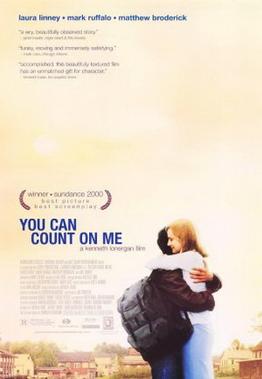
After co-writing the film Analyze This with Harold Ramis and Peter Tolan in 1999, Lonergan's next project was as big a breakthrough in the world of film as THIS IS OUR YOUTH had been on the stage. Reuniting Lonergan with Mark Ruffalo, the film follows an estranged brother and sister (Ruffalo and Laura Linney). They reunite when he returns to the Catskills community where they grew up, but his arrival subtly throws her life into disarray, slowly forcing them into conflict.

Lonergan directed the film, as well as wrote the screenplay, and critics took note. Many placed the film on their best-of lists for 2000, specifically citing Lonergan's "bottomless dialogue" and the film's emphasis on making everyday problems as compelling as high drama. Before the awards season was over, You Can Count On Me would pick up dozens of wins and nominations, including two Oscar noms and two awards at Sundance including the Grand Jury Prize.

THE STARRY MESSENGER (2009)

The '00s marked a creative drought for Lonergan (partly for reasons discussed in the next entry), but he would finally return to the stage in 2009 with THE STARRY MESSENGER, his first fully produced play since LOBBY HERO opened in 2001 and his debut as a director of his own work. A star vehicle -- pun only slightly intended -- for Matthew Broderick, MESSENGER orbits around a 40-something married man who works at the Hayden Planetarium and unexpectedly connects with a single mother.

MESSENGER didn't receive the same adulation as Lonergan's earlier works for the stage, but his ear for dialogue and unique mix of comedy and drama was once again highlighted even in mixed reviews (a fate shared by Lonergan's most recent play, HOLD ON TO ME DARLING, which opened earlier this year at Atlantic Theater Company).

Margaret (2011)

After the success of You Can Count On Me, Lonergan had a number of writing and co-writing gigs in Hollywood, including the screenplays for the sequel to Analyze This and Scorsese's Gangs of New York. But his most anticipated film was Margaret, a drama starring Anna Paquin about a teenage girl who believes she helped cause a traffic accident that killed a woman.

Filmed in 2005, Margaret was intended for release in 2007, but Lonergan and the film's studio, Fox Searchlight Pictures, disagreed on the film's runtime. Fox insisted on a tight 150 minutes or less, while Lonergan's own edit was closer to three hours. The legal battle ate up years, and ultimately concluded with two versions of the film being released -- a 150-minute edit, which hit theaters in limited release in 2011 and was commercially unsuccessful, and an extended cut released on DVD in 2012 completed by Lonergan. Despite all the drama, the final release of the film received raves from many critics, and Lonergan himself says he's happy with the final cut.

Manchester by the Sea (2016)

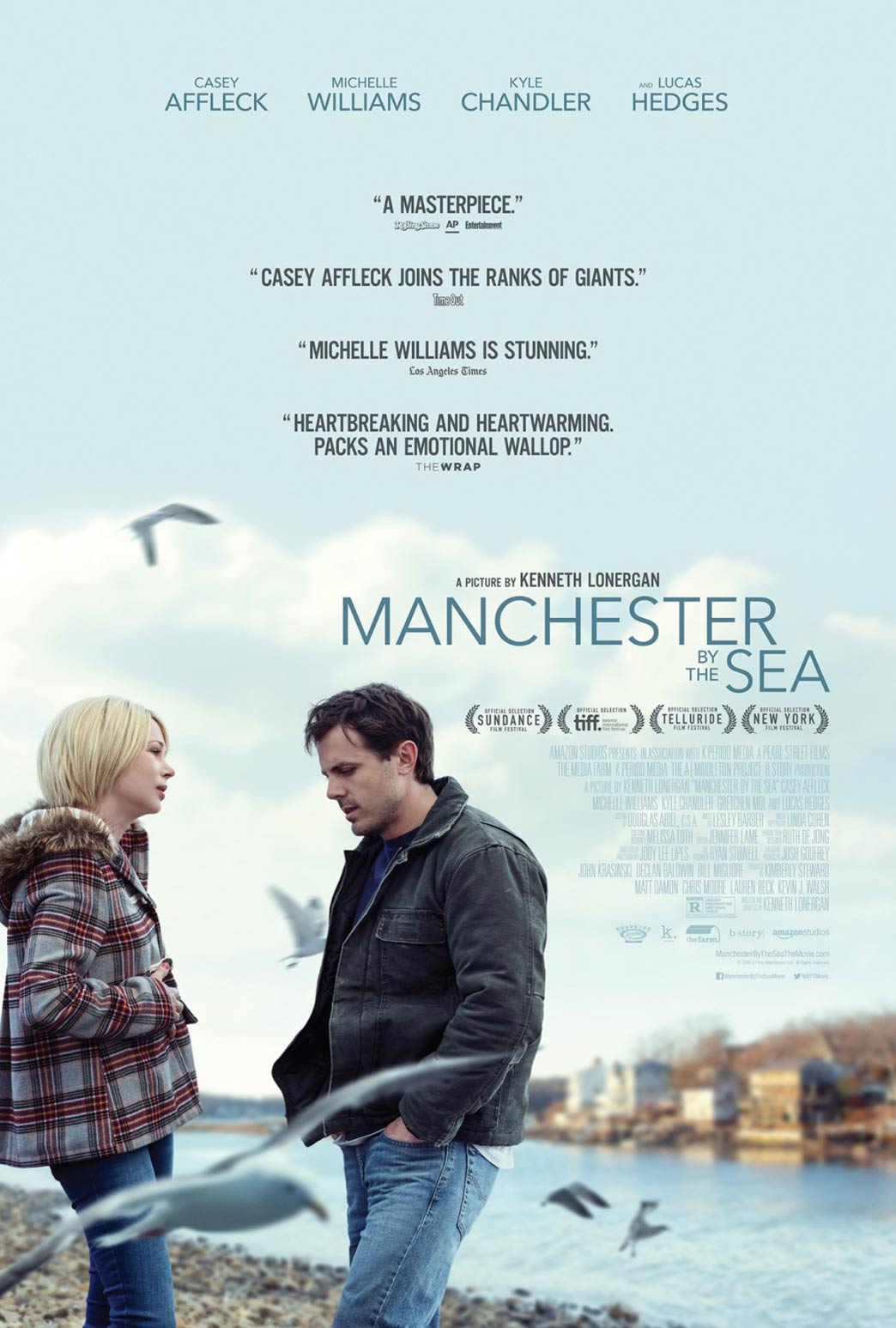
No such disputes marred the development of Lonergan's latest film, his third as a writer/director. Manchester by the Sea, set to be released in select theaters on Nov. 18 before a wider release in December, tells the story of a self-isolated man (Casey Affleck) who must unexpectedly return to his hometown to care for his nephew when his brother dies, and in the process revisits his greatest personal tragedy.

Originally, Lonergan was only booked to write the script -- the original idea came from producer Matt Damon, who had planned to direct himself and recruited Lonergan for the screenplay. But scheduling conflicts shifted Lonergan into the director's chair as well, and he would shape the film with his own vision.

Buoyed by strong advance reviews, early acclaim (a Hollywood Screenwriter Award for Lonergan and five Gotham Award nominations) and lots of Oscar buzz, Manchester looks poised to make this Lonergan's year. All the more reason to catch MCT's LOBBY HERO now -- before all the hype kicks in.

Thursday, August 4, 2016

So who are Vanya, Sonia, Masha and Spike anyway?

by Matthew Reddin, MCT marketing director

We're only a week away from opening night for VANYA AND SONIA AND MASHA AND SPIKE, but there's one question left to answer: Who are these people?

Answering that honestly? There be spoilers. But we can hint at more than enough about the six characters who'll appear on the Cabot Theatre stage using the words of the best authority on the subject: Christopher Durang, the playwright who wrote the play in the first place.

In his Author's Note in the published script of VANYA AND SONIA AND MASHA AND SPIKE, Durang writes that the names of his first three titular characters are lifted from Chekhov, with a "very modern" name to jar the listener into laughter. But he also adds that "the play is not based on Chekhov, nor is it a parody of Chekhov. ... It's as if I took characters and themes from Chekhov and put them in a blender."

In a sense, then, these abridged character descriptions, all in Durang's words, could be likened to a tasty sextet of summer smoothies. Drink up -- we'll see you at the theater.


VANYA (C. Michael Wright)

He has mostly lived in the house he grew up in. I feel that he went to college but then came home expecting to stay only a while. But he stayed the rest of his life, partly to take care of his parents as they suffered a long period of illness and then died.

SONIA (Jenny Wanasek) 

She was adopted. She was 8 when she joined the family. Vanya was probably 10 or 11, Masha was probably 13 or even 14. When their parents decided to adopt Sonia, they undoubtedly told their two older children to be kind and welcoming. And I think Vanya did like Sonia pretty quickly, and they were closer in age. Masha was already in her own world.

MASHA (Carrie Hitchcock)

Masha is a successful actress and movie star who has a glamorous life, and is a millionaire from her successful Sexy Killer movies. There are many prototypes of the self-involved, glamorous actress: Madam Arkadina in Chekhov's The Seagull, Judith Bliss in Noel Coward's Hay Fever, and Bette Davis as Margo Channing in the classic film All About Eve.

SPIKE (JJ Phillips)

Spike is Masha’s “beloved,” as she says. But basically they have been together for three months, and their age difference is really rather big. Spike genuinely likes and finds Masha attractive, but as a young man he has a non-stop eye for lots of women, including young women.

CASSANDRA (Rána Roman)

I have always loved the Greek tragedy character of Cassandra, who sees the terrible future ahead and warns people, but the god Apollo has cursed her so that no one believes what she prophesies. Cassandra has pretty much no connection to Chekhov, but my impulse was to give Vanya and Sonia a cleaning woman who had the name Cassandra and could indeed see the future, at least somewhat.


NINA (Elodie Senetra)

Nina is indeed somewhat like Nina in The Seagull. In Chekhov, she is an aspiring actress, and she is agog at meeting Madam Arkadina. But my Nina is also American, and she has rather classy tastes. She is very young and full of hope.

VANYA AND SONIA AND MASHA AND SPIKE, directed by Marcella Kearns, runs August 11 to 28 at the Broadway Theatre Center's Cabot Theatre, 158 N. Broadway. For tickets and additional information, call 414.291.7800 or visit milwaukeechambertheatre.com.

Wednesday, February 10, 2016

In Rehearsals for SLOWGIRL!

By Alexander Coddington

We’ve just begun work on our second week of rehearsal for SLOWGIRL.  As Michael Wright’s assistant director (and friendly neighborhood MCT Audience Development Coordinator), I will be providing eager Chamber-holics, as some of our biggest fans like to call themselves, at home with a glimpse into the magic that goes on inside Rehearsal Hall 5B.

Our first week kicked off with a meet-and-greet reception where many of you had the opportunity to mingle with the artists involved with the show.  (First rehearsal meet-and-greets are just one of the many perks of being a member of the MCT Friends – contact me for more information about joining the Friends at alex@milwaukeechambertheatre.com!!)

Scenic Designer Keith Pitts' model of Sterling's Costa Rican hut
We got to hear some insights into Michael Wright’s directorial vision for the play, which follows a girl and her uncle through an emotionally tumultuous week in the Costa Rican jungle, look at beautiful preliminary design renderings by costume designer Kimberly O’Callaghan (COLLECTED STORIES, CRIMES OF THE HEART) and an intricate miniature model of the set made by scenic designer Keith Pitts (‘ART’, AROUND THE WORLD IN 80 DAYS), and heard actors Peter Reeves and Sara Zientek read Greg Pierce’s play aloud.

Peter returns to MCT after appearing in THE SWEETEST SWING IN BASEBALL in 2010 and A WALK IN THE WOODS in 2007. He is currently the Communications Director for Pius XI Catholic High School in Milwaukee. However, after SLOWGIRL closes he will be moving to Pennsylvania – so this may be his last appearance on stage in Milwaukee. He has appeared in numerous films and commercials and has performed with Next Act Theatre, Renaissance Theaterworks, First Stage, American Inside Theatre and Next Generation Theatre.

Sara made her MCT debut in MAURITIUS in 2011. She was part of the Milwaukee Repertory Theater Emerging Professional Residency. She has also worked with First Stage, InTandem Theatre, Splinter Group, Umbrella Group and Optimist Theatre.  She has been a teacher for First Stage, Waukesha Civic Theatre and Next Act Theatre, and was also a part of an educational tour of ROMEO AND JULIET with Utah Shakespeare Festival. She received her BA in acting from UW-Milwaukee.

Peter Reeves and Sara Zientek rehearse a scene from SLOWGIRL

So far, it’s been smooth sailing down to Costa Rica, but that doesn’t mean we’re not hard at work!  It’s an emotionally challenging and structurally interesting play that has been a thrill to experience in the rehearsal room.  Salud!

Thursday, February 12, 2015

A Long History With Fugard

An Interview with C. Michael Wright
[ Director of The Train Driver ]


A Long History With Fugard
by Michael Cotey

Michael COTEY: You've had a lengthy relationship with playwright Athol Fugard and his work, as both director and actor. Walk us through that history.

Michael WRIGHT: Athol Fugard is one of my heroes.

I first met him back in 1982, when I auditioned for the Broadway production of his semi-autobiographical play "MASTER HAROLD" ...and the boys, which he also directed. At the audition, Athol actually got up on his feet and read scenes with me! I'd never had a director - much less a director who also happens to be the playwright - read with me in an audition situation. But that's the kind of man he is. He's a true artist, totally invested in the work, diving into every project with his body, heart and soul.

I was incredibly fortunate to then be cast as understudy to the lead and was able to perform the role for two glorious weeks on Broadway. Immediately after that, I played the role in the national tour, which included a few weeks in Toronto and a tour of five cities in Israel. Not only was Athol my director, he was also my mentor and my guide. He used to take me out for breakfast and tell me in-depth stories about growing up in South Africa. What a gift that was to have personal background about your character handed right to you! I vividly remember how kind and generous he was to strangers; he was as warm and open with waiters and box office staff as he was with his artistic colleagues. But at the same time, he was never reluctant to fully speak his mind or fight for what he believed in. I consider him a man of great integrity and I really learned a lot from him.

L-R: Delroy Lindo, C. Michael Wright, Athol Fugard and James Earl Jones,
 "MASTER HAROLD" ...and the boys (1983)

Coincidentally "MASTER HAROLD" ...and the boys was the show that first brought me to Milwaukee. A year after I left the tour, I performed the role one last time at Milwaukee Rep. (That's when I first came to Milwaukee and I fell in love with the city!) And then, many years after that, I directed my own production of the play at Next Act Theatre.

COTEY:  And you keep returning to him. What is it about Fugard's work you find compelling?

WRIGHT: First and foremost, I love the issues he writes about. I've always been particularly attracted to stories about injustice and the struggle between the haves and the have-nots.

Even though Athol's plays are specific to his South African experience, his themes are universal. He's incredibly courageous, not afraid to tackle extremely difficult topics head-on, even though his work has often been banned in South Africa. He would often say that he doesn't consider himself to be a political writer, just a storyteller. But the stories he chooses to tell have such profound impact and resonance.
Besides that, his language is so beautifully rich.  There's an almost heightened, poetic quality to it, balanced with a surprising simplicity and purity. And yet he's not shy about including a visceral, sucker-punch to the gut that can leave you reeling.
COTEY: THE TRAIN DRIVER has been said to be Fugard's response to post-Apartheid South Africa. Does this play carry a different feeling than the work he wrote previously?

WRIGHT: The majority of Athol's plays, especially his earlier works, are all intense and hard-hitting. Some of his newer pieces have become quieter and more introspective, but THE TRAIN DRIVER is a definite return to his roots.

I find this quote from Athol pretty revealing: "This is for me the whole; it's my truth and reconciliation. I think all of my writing life led up to the writing of THE TRAIN DRIVER because it deals with my own inherited blindness and guilt and all of what being a white South African in South Africa during those apartheid years meant."

COTEY: Why this play? Why now?

WRIGHT: Not only do I have a long history with Fugard's plays, Milwaukee Chamber Theatre has one, too. Since this is an anniversary season, I thought it would be perfectly fitting to include one of his plays, combining my own personal history with MCT's. THE TRAIN DRIVER will be the fifth Fugard work produced here. (Interestingly enough, Shaw is the only playwright that's been performed here more than Fugard!)

Frankly I've wanted to direct this play ever since I first read it. But it's an extremely challenging piece. I needed to wait until the time was right for me to take this emotional journey to a very dark place. I wanted to make certain I was ready to commit to it 110%, just as Athol would, and approach it with enough clarity and focus.
Besides it's always time for strong, important plays that make you think about how you look at, and fit into, the world around you.
COTEY: How do you hope it will resonate with a Milwaukee audience?

WRIGHT: I hope it provokes much discussion about how we treat our fellow man and about the power of letting other people and other cultures into our circle.

COTEY: How do you prepare as a director?

WRIGHT: That varies pretty dramatically from project to project. I always try to read the script a lot, highlighting important lines or sections and making some notes. Sometimes I jot down staging ideas; sometimes I even play with the scenic model, arranging furniture and moving figures around. Sometimes I like doing fun research, like exploring artwork, music, films that just inspire me or are somehow representative of a specific style or time or location. Most importantly, I always try to spend time actually visualizing movement, stage pictures and specific moments that I want to capture. I also try very hard to see another production in the same theatre, so that I get a good sense of the playing space. Even if I've worked in a particular theatre before, I still like to sit in it again with an audience to be reminded of the general vibe of a space, as well as any sightline issues or acoustic challenges.

COTEY: I think most people have a vague idea what a director does in the room with his or her actors. How do you view the director's role in rehearsal?


WRIGHT: I think it's a director's primary responsibility to provide a safe and stimulating environment where ideas can be shared and creative risks can be taken. For me, it's very important to come into the process with some strong thoughts and opinions, but also with openness to new thoughts and opinions. I view the director as the "parent" in the room, overseeing the activities in a "playground," guiding the actors as they play, while generously encouraging collaboration and mutual ownership of the work.

Friday, February 6, 2015

All Aboard THE TRAIN DRIVER!

L-R: Michael A. Torrey (SIMON HANABE), David Daniel (ROELF VISAGIE),
and director C. Michael Wright at the first read-through for The Train Driver

My name is Alexander Coddington and I am Michael Wright’s assistant director for this winter’s production of THE TRAIN DRIVER, running in the Studio Theatre from February 25 through March 15.  Throughout the month, I will be periodically updating you on the rehearsal process upstairs at Chamber as we prepare to present Athol Fugard’s powerful drama of post-apartheid South Africa inspired by an actual event.

We’re wrapping up our first week of rehearsals today, and so far it’s proved to be a really exciting show.  Our first day, we had a meet-and-greet with the cast and production team and read the script for the first time.  Also in attendance were friends of Chamber and representatives from UPAF, and during the Q&A we received some very insightful questions about the script and the process of producing a play.

For such an intense two-character play, it’s hard to believe that David Daniel and Michael Torrey met each other for the first time at that read-through.  One of the great things about this play is the characters show us through the bonds of their new friendship that it is possible to meet a stranger and create a very honest, meaningful connection with someone, so it will be fascinating to watch David and Michael get to know each other at the same time Roelf and Simon do.

David Daniel returns to MCT after appearing in ANCESTRAL VOICES (2001) and THE HERBAL BED (2002). He is a Core Company member at American Players Theatre in Spring Green, Wisconsin where he also serves as the Education Director. Previous Fugard work includes EXITS AND ENTRANCES in APT's Touchstone Theatre in 2010. He is a graduate of the Professional Theatre Training Program at the University of Delaware and a veteran of the United States Army.

Michael Torrey returns to MCT after performing in DRIVING MISS DAISY (2011). He also appeared in Next Act Theatre's 2005 production of Fugard's “MASTER HAROLD” …and the boys, directed by Michael Wright. He has performed with First Stage in A MIDNIGHT CRY, THE LION, THE WITCH AND THE WARDROBE and THE TRUE CONFESSIONS OF CHARLOTTE DOYLE. Currently based in Chicago, he has worked with theatre’s including The Goodman, Chicago Shakespeare Theatre, Theatre at the Center and New American Theatre.


Michael Wright has continually said through the pre-production process that THE TRAIN DRIVER is not a tragedy.  Though it may seem on the surface to be his most tragic work, at its core it is a play of great hope and the triumph of finding hope in a hopeless world.  It is a play of great danger, but also a play of great humor.  A haunting ghost story without ghosts, Fugard has breathed an incredible amount of empathy into this beautifully written script that is perfect for MCT audiences: fiercely intelligent, brutally honest, and full of surprises at every turn.

Friday, February 28, 2014

A #1 rating, An Article about Lori Matthews, and Another Round of Reviews


We're #1 in Milwaukee Magazine's World Premiere Weekend
  
"Why? Because MCT’s Monty Davis Play Development series has brought some great Wisconsin voices to the stage, nurturing and staging premieres by state playwrights."

 A Flair for the Dramatic
Connect Stoughton's article about the playwright of October, Before I Was Born, Lori Matthews.

Waukesha Freeman
"The set design by Charles J. Trieloff II is detailed and authentic, and the costumes by Andrea Bouck reflect the contrast between Anne and the family she married into."

Tom Strini Writes
"The most important thing happens among and within Martha, April and even hapless Houston. They've all come to know one another and themselves a little better as they passed through the ordeal. They've become a little stronger. They know that whatever the news, they can handle it.
Best of all, Matthews doesn't make them say it. No noble speeches in this play. Anne and Martha simply stand together on the porch and gaze stoically toward the headlights. They will endure."


 Broadway World
"C. Michael Wright's direction mingled with Matthews's script allows the audience no comfort in a tidy conclusion when the palpable uncertainty to these mass human tragedies comes alive on stage. What does one do during these horrific events? Just listen or stare at the pictures on a media screen, especially in the 21st century, where destruction can be endlessly paraded before an audience?"

Wisconsin Gazette
"Much of the play’s success has to do with the emotions Matthews brought to the writing process, which helped her to deal with the deaths of her parents, even though neither of them were harmed in the blast."

Wednesday, February 26, 2014

Reviews

 Check out what reviewers are saying about OCTOBER, BEFORE I WAS BORN

  
Third Coast Daily- 
"I’ve for years enjoyed McMillion’s commanding stage authority portraying domestic anchors and conveying homespun pragmatism. But here she believably adds a growing sense of hidden tension, self-doubt and even anger at the growing failure of the younger generation to match her stubborn traditional roots."

Milwaukee Magazine-
"There is more than a touch of Tennessee Williams in April Paul’s Anne and Ken T. Williams’ Houston. The “charm of the defeated” for sure, but also the familiar push-pull between yearning and circumstance."

Tap Milwaukee (Journal Sentinel)-
"But the heart of this often very moving play doesn't involve the disaster that sets it in motion, but rather Matthews' quiet and probing exploration of how we respond. Do such disasters bring out the best or the worst in those living through them?"

Shepherd Express- 
"Director C. Michael Wright deftly balances the growing tension of the factory explosion’s outcome with the emotionally charged atmosphere inside the family home."

Wednesday, February 5, 2014

HONORING A REGION: An interview with playwright Lori Matthews


By Marcella Kearns, MCT Lead Educator and Literary Manager

1960.  Senator John F. Kennedy runs against Vice President Richard Nixon for the office of POTUS.  TO KILL A MOCKINGBIRD by Harper Lee is published, and Hitchcock’s PSYCHO is released.  Arnold Palmer wins the U.S. Open golf championship.  Students protesting segregation in the United States hold sit-ins at whites-only lunch counters at Woolworth.  Wisconsin faces Washington in the Rose Bowl and loses 44-8.  The first weather satellite to broadcast television images of cloud cover is launched by the United States…
Events most significant to us tend to etch such minute detail into our memory and senses that we can place ourselves in those circumstances again effortlessly (whether we wish to or not).  For the residents of Kingsport, Tennessee and the surrounding area, the events of October 4, 1960 have that dread weight.  Lori Matthews, playwright of OCTOBER, BEFORE I WAS BORN, hails originally from Kingsport, though she now makes her home in Stoughton, Wisconsin.  She was born, as the title of this semi-autobiographical piece implies, less than a year after tragedy struck her hometown.  Just before the first rehearsal and read-through of the play for MCT’s production, she sits with me in MCT’s conference room to discuss her connection to the story and what drew her to explore it as the background for her family drama.

“I imagine it’s similar to people who were in Hawaii for Pearl Harbor, people who were in Dallas when JFK was shot,” she says.  “There’s something that happens in your backyard that changes the way the world looks the next day.  In our area, for a long time, it was this accident.  People knew where they were when they heard the explosion or what they did after.  It was rural folklore.”  The memory extends far beyond the boundaries of the region, as we’ll discover.  In less than half an hour, Ken Lukow, an MCT Friend and retired engineer attending the read-through, will recall for Lori how his company at the time worked with Tennessee Eastman—how he still recalls hearing the news.

Tennessee Eastman Company, a chemical manufacturing corporation, was and remains (as Eastman Chemical Company) the largest employer in the region around Kingsport, Tennessee.  In 1960, over 12,000 employees worked at the complex—“To see it, it looks like a city in itself,” Lori shares.  Around 4:45 PM on October 4, Building 207 of the aniline division of the plant exploded, sending a mushroom cloud into the sky and shattering glass in buildings up to four miles away.  Containment of the subsequent fire and retrieval or rescue of victims of the explosion took the efforts of emergency responders and residents from several neighboring towns and cities.  Lori continues, recalling her research and stories from relatives: “Even though it was a huge company, there was still a sense of community—it left the people in charge broken-hearted that it happened.  Communities gathered to give blood, Boy Scout troops to pick up trash and aid in repairs…At that time, it was everyone’s plight.”  A community tragedy, in other words, also became a community response.
 
For those who experienced October 4 and even for those who were born after, the event was indelible.  Lori herself grew up a child of Tennessee Eastman employees.  She recalls going to Horsekrickers on Saturday mornings, where children of employees could see movies, roller skate, and socialize, and seeing a piece of shrapnel from the explosion across the street.  She recalls a more pivotal moment in the history of the play’s inception, then: years later, when her mother was in the hospital and Lori was visiting, a nurse came to take some vitals.  Her mother noticed that the nurse had the same last name as one of the victims of the explosion, and she wondered if the two were related.  Then her mother uttered a phrase which would stick: “In October, before you were born...”

For Lori, her mother’s recall of the event, her hometown’s experience, and Lori’s personal circumstances—culminating in being with and waiting for news of her mother in the hospital—ultimately provided seeds for the fundamental questions of the play itself.  The notion of any period of suspense in one’s life, whether due to illness, emergency, or opportunity, led her to explore the situation in which audiences will see characters in OCTOBER—three family members waiting to hear about news of loved ones who were at the plant at the time of the emergency.  “How do you fill that time?  What do you do with yourself?  How does that shape how you think about life [in the interim, or after]?  In writing I tried to stay true to what I did know about waiting, filling the time, the worry; the questions of do you think hopefully?  Do you prepare for the worst?  And what do you do when you’re stuck in a room with someone you don’t normally get along with, besides?”  Though the characters involved are rooted squarely in fiction, Lori explains that she wished to take great care in handling the history in which they’re placed with gentleness and respect.  Ultimately, she hopes asking those questions against the backdrop of an intimate part of family and community history honors all those involved in or affected by the event in Kingsport—and, in wider scope, to anyone who has endured a period of waiting, whether the end result is loss, disappointment, relief, or triumph.

Our conversation detours, then, to end in affectionate reflection for the geography in which OCTOBER is set.  Lori mentions that about 60 members of her family attended the world premiere at the Barter Theatre in Virginia and confesses that much of her inspiration in writing stems from the Appalachian region of her birth.  I ask her if for that reason she considers herself a regional writer, despite adopting Wisconsin as her home.  She concurs.  “When I was in graduate school, I had a movement teacher who asked me how I had adjusted to indoor plumbing when he found out I had come from eastern Tennessee…  The stereotype of Appalachia is really different from what I know.  Part of the driving force in many of the pieces I write is to honor the truth of the situation and to correct the stereotype.”  She’s thrilled with the care in the acting and design work already in progress at MCT—from scenic designer Jen Trieloff’s wallpaper choices to Raeleen McMillion’s dialect.

We’re thrilled to have her with us.

Thursday, March 28, 2013

Carrying On: Why Wodehouse Sticks

by Marcella Kearns, MCT Guest Educator

Recently, on a whim, I asked a fellow coffee shop patron if he knew anything about P.G. Wodehouse.  I was beginning research for JEEVES IN BLOOM, Margaret Raether's second adaptation of Wodehouse's Jeeves stories, and we were in a chatty space.  He shook his head.

kearns"British writer?" I prompted.
"Oh, yeah.  Winnie the Pooh…?"
"Jeeves."
"Oh.  Oh, yeah!  Ask Jeeves!  On the internet.  The search engine.  Not around anymore, though."
"Yes, in a way."  (It's been shortened to "Ask.com.")
"Jeeves.  He was a butler, right?"
"Not exactly, no-"
Then it hit.
"He knew everything."
"Yes," I said.  "Yes.  He knew everything."

He knew everything. That someone to whom Sir Pelham Grenville Wodehouse himself was unfamiliar could nevertheless nail the defining feature of one of his creations tickled me.  Nearly a century after Wodehouse's beloved characters Bertie Wooster and his valet, Jeeves, appeared in print for the first time, this master-servant pair continues to find new life and loving audiences in all media.  Short stories and novels remain in print around the world.  Jeeves and Wooster stories have been adapted into films, television series, and plays over the course of several decades.  For those who don't know the man, Wodehouse's work, at least, continues to occupy a place in Stateside pop culture.  What about his stories sticks for us?  What, exactly, is the appeal, a century after he was coming into his own as a writer?

Craft and Style


Wodehouse had a keen instinct for the theatrical in both plot and word, and it's from that point that I launched a search which would take me through biographies, several Jeeves collections, and delightful conversations with playwright Margaret Raether and actress Karen Estrada.

WodehouseBy the mid-1920s, Wodehouse was established on both sides of the Atlantic as England's premier comic writer.  While he often gravitated to the short story, he was no stranger to writing for the theatre.  In the later teens, in fact, he began to collaborate with Guy Bolton and Jerome Kern, among other greats of the early 20th-century American musical theatre, to serve as lyricist and co-librettist on Broadway projects.  The team of Bolton, Kern, and Wodehouse served to set a new standard for the seamless integration of lyrics, music, and book into a cohesive story-something musicals hadn't heretofore made much of a priority.  Essentially, they helped mature the form.

Wodehouse credited the stage with helping him hone his own craft in prose: "I've found that writing musical comedy has taught me a lot," he wrote to his friend Bill Townend.  "In musical comedy you gain so tremendously in Act One if you can give your principal characters a dramatic entrance instead of just walking them on."1

RaetherEven as Raether attests that plotting is the most difficult part of her playwriting process, she praises Wodehouse for his ability to craft an airtight, improbable sequence of events and seeks to nail that spirit of screwball comedy in her own work.  "My favorite word to write is 'pandemonium,'" she shares.  "It's in all of my scripts.  It's good to be on hand for the first production because then I can help work out what happens.  'What do you want here?' I'm asked.  'Pandemonium!' I say."

Wodehouse's writing style seems as effortless in its complexity as his plotting.  His work is peppered with allusions to literature, the quirkiest of images, unabashed Edwardian slang, and sentence construction that gives any actor a breath-support workout.  Karen Estrada, who will play the socialite Madeline Bassett in JEEVES IN BLOOM at MCT, rhapsodizes about the richness of Wodehouse's text: "I love the 'Britishness' of it: the slang 'eggs and b' instead of eggs and bacon, for instance.  He writes lyrics and poetry, prides himself on G & S turns of phrase and cleverness."  Raether echoes the praise, pinpointing what for her draws us to the language: "It's a fabulous combination of silly funny and smart funny.  Wodehouse's wordplay is brilliant.  And we get the benefit of both.  Even as we laugh at the joke, we pat ourselves on the back for getting it."

Escape


Neatly plotted comedy and sharp prose aside, Wodehouse's work is Exhibit A in the argument for flat-out escape as a major benefit of fiction.  As common a purpose for entertainment as it is, the balm of escape is often unacknowledged.  Wodehouse's world purposefully keeps the worst of reality at bay.  Many of his stories sit squarely in an idyllic pre-war Edwardian England in which social struggles are distant, if not invisible.  In a BBC broadcast honoring Wodehouse in 1961, Evelyn Waugh likened Wodehouse's world to Eden.  Biographer Robert McCrum quotes the novel Something Fresh as insight into Wodehouse's intentional removal from the cares of the world: "Other people worried about all sorts of things-strikes, wars, suffragettes, diminishing birth-rates, the growing materialism of the age, and a score of similar subjects.  Worrying, indeed, seemed to be the twentieth century's specialty.  Lord Emsworth never worried."2

estradaEstrada and Raether both reflect on that delicious retreat-the safety and dazzle of Wodehouse's fictional England-when I speak with them.  "It was such a strange time," laughs Estrada.  "They had money and nothing to do, so they could collect weird things and have bizarre passions and pursuits.  What does Madeline do?  Nothing."  The worst of Madeline's travails are in firming up to whom she's engaged.  Raether muses, "I've always been fascinated by the fact that during a tremendous depression-people didn't resent movies about this kind of thing.  They didn't want to burn down the cinema.  For them, it was fun to visit a world where everyone wears those divine gowns to dinner."  Her reflection takes the analysis one step further.  "Perhaps it isn't just the clothes or the social status.  In fact, there is perhaps something satisfying about the fabulously wealthy getting into a tizzy, into fabulously ridiculous predicaments."

Did this ideal world, this attractive place to escape, ever exist?  Herbert Warren Wind recalls a gathering of Wodehouse and friends at the Patio, a restaurant in Westhampton Beach, in the early 1970s.  As a friend asked Wodehouse that very question, the writer, then a long-term exile from England, replied.

Oh, it very definitely existed.  When I was living in London around the turn of the century, a good many of the young men dressed in morning coats, toppers, and spats-or spatterdashes, to give them their full name.  I wore them myself when I paid afternoon calls.  I don't know why spats went out of favor.  They were very comfortable, you know.  Awfully warm.  Anyway, when I started writing my stories, Bertie was a recognizable type.  All the rich young men had valets.  Funny how fast a type disappears!  After the war, there wasn't nearly so much money around, so the young men had to go out and find jobs, and this sort of pulled the rug out from under a whole way of life.3

With the rug pulled out from a "whole way of life," Wodehouse provided-still provides-a haven.  He wrote to Townend, "There is the problem of whether to ignore the upheaval in English life and go on doing Blandings Castle and Jeeves stuff or try to do something modern… I believe people having a rotten time in England like reading of the days when there were butlers and so on."4 Certainly, what sold was escape-what audiences craved and needed given their own circumstances.

Reliability


Providing what was needed: that thought led me back to Bertie and Jeeves themselves, characters recognizable even to the unindoctrinated, and the question of their enduring appeal.  Estrada discusses the characters as warmly as though she's discussing old friends:  "Bertie is absolutely aware of his own stupidity most of the time.  How he relies on Jeeves!  We never hear anything from Jeeves' point of view [Bertie narrates the fiction], but we can tell how he has made the entire arc of the story work for himself."  Raether puts it another way: "In his own aristocratic way, Jeeves has fun.  Bertie offers more scope for his talents than anyone less talented at getting himself into difficulties."  Indeed, Jeeves' ability to plot a path that will extricate Bertie and neutralize a conflict with the best possible outcome for all players (including himself) appears superhuman, his knowledge and observation omniscient.  We, as audience, can't help but wonder how much of a kick he gets out of it.

Jeeves isn't alone in his reliability, however.  Bertie Wooster adheres to a strict personal code-never let a friend down-that invariably costs him sleep, time, reputation, and money (fortunately, the latter is in ready enough supply).  His code has a knack for landing him in trying and comically ripe scrapes on behalf of his friends, true, so Bertie is fortunate to have Jeeves; but both together bring a heart and brain to a puzzle that readers and audiences can be certain will manage to win the day.

Perhaps that's one key to Wodehouse's lasting appeal.  His world, light-hearted, carefree, is five-star in the way of fictional escapes.  His language is searingly funny, his comedy deft.  But his heroes-Bertie Wooster and Jeeves-are true to those they serve: friend, family, employer.
And audience.

1 Wodehouse's letter to William Townend (1922) quoted in Wodehouse: A Life by Robert McCrum (2004), 150
2
Something Fresh quoted by McCrum, 116.
3
Wodehouse quoted in The World of P.G. Wodehouse by Herbert Warren Wind (1971), 98.
4
Wodehouse's letter to Townend (1950) quoted by McCrum, 374.

Tuesday, March 12, 2013

Young Playwrights Festival Winner H'Vyn Jones

YOUNG PLAYWRIGHTS FESTIVAL 2012-2013: Messmer High School graduate H'vyn Jones is one of our three winning playwrights! Her one-act play, JUST ANOTHER DAY IN DENTURES, will presented at each performance, March 21-24, 2013.
Playwright H'Vyn Jones
 

What is it like to have your work recognized and produced by a professional theatre company like Milwaukee Chamber Theatre? 
Having my work recognized and produced by a professional theater company like Milwaukee Chamber Theatre is remarkable! Through this experience I realized that I have real talent in writing, and I am honored that Milwaukee Chamber Theatre gave me the opportunity to strengthen my talent.

Have you worked at all with the director/cast to edit the script?  If so, what was this process like? 
The director and I got a chance to edit and revise the script together, and whenever she had a suggestion she would let me know. This made me feel like I was really a part of the process even though I could not physically be with the cast to make those changes.

Just Another Day in Dentures deals with a family finding connections previously thought not practical or possible.  What inspired you to write a play like this? 
My play Just Another Day in Dentures started off as an English assignment in my junior year of high school. I was not sure what to write, but I knew I wanted to write about something different and out-of-the-box. I talked it over with my family, and it took a few days for me to finalize my topic, but once I did all my creativity started flowing out of me. I have a really strong relationship with all of my grandparents, and I understand that not everyone has that, so I wanted to really capture that relationship and make it into a play.
  
What do you want the audience to take away or learn from watching this play?
I want the audience to realize that the elders in our lives have a lot to offer us and we should show our appreciation more often. I think the younger generation today sometimes forgets to do that.
  
Is playwriting something you are considering as a career path?
Although I have not considered playwriting as a career, I have considered acting as a career because I have always enjoyed drama and the theater.

Thanks H'vyn! Don't miss the YOUNG PLAYWRIGHTS FESTIVAL, March 21-24, 2013.