Showing posts with label Milwaukee Chamber Theatre. Show all posts

Tuesday, April 9, 2019

Embracing Uncertainty: BEN BUTLER in Rehearsal

by Mike Fischer


“There is a law. The law is clear. Fugitive slaves must be returned to their owners.”

So says General Benjamin Franklin Butler to runaway Virginian slave Shepard Mallory. Mallory is seeking refuge in the Union fort Butler commands in the heart of Virginia. Less than 24 hours earlier, Virginia had formally seceded from the United States. 

As playwright Richard Strand suggests in his play BEN BUTLER, things aren’t nearly as “clear” for Butler as he’d initially imagined. Butler may later say to Mallory that “everything is fine like it is.” But throughout Strand’s play, both the law and life itself prove otherwise, springing surprises that will forever alter the script Butler inherited – while making him a pivotal player during one of the most significant dramas in all of American history.  

With a hefty assist from Mallory, both Butler and his adjutant – Lieutenant Kelly – eventually open their hearts to the prospect that they might play their scenes in that history differently. Strand approached his play with a similarly open mind. “It is hard for me in retrospect,” he said during a March 2016 interview in American Theatre magazine, “to be sure what I had in mind when I wrote the play.”

For trained lawyers like Butler, soldiers like Kelly – and, yes, theatre artists like Strand – moving forward often involves summoning the courage to be uncertain or even lost. Straying from the path opens one to new ways of seeing. It frees the mind of the rituals and conventions that lead us to trace increasingly narrow circles. And it’s integral to how the phenomenally talented Michael Cotey approaches directing, as he’s making clear once again in directing Milwaukee Chamber Theatre’s production of BEN BUTLER.

Multiple Choice(s) . . .

I spent time with Michael and his cast during the second week of BUTLER rehearsals. 

Michael Cotey (left) and the cast of BEN BUTLER:
Marques Causey, Drew Brhel, Chase Stoeger,
and David Sapiro.
The cast’s initial three days of invaluable table work – during which they’d explored the historical background to Strand’s play, as well as what makes their respective characters tick – were now behind them. Full runs of the play – during which the cast starts from the top of the show and works all the way through to the end – were still ahead of them. 

The rehearsals I attended occupied that unsettling but also exciting middle period during which actors were first on their feet, immersing themselves fully in each scene while playing with everything from where they moved to when and how Mallory nudged Butler and Kelly toward a moral awakening. 

Does that awakening happen for both men all at once, like an epiphany? Or did they – like most of us whose nagging conscience natters away at us even as we stubbornly continue to sleepwalk – gradually stumble toward a new dawn?

In challenging his actors to answer such questions, Michael urged them to exercise what Keats once referred to as “negative capability”: opening their minds to the many ways one might play a scene, without prematurely feeling compelled to choose one of them. Actors understandably want to lock down how long they hold a beat, how to inflect a line, and when to move in on a scenic partner; at some point they must do these things so that a production can cohere. 

But just over one week into the rehearsal process, Michael was in no rush for his actors to get there. Doing so risked overlooking possible solutions to a scenic problem – just as Butler risked missing a legal and practical solution to the dilemma posed by runaway slaves if he assumed he already knew all the answers. 

Butler, like the actors embodying this story, needed to take time to ask questions. Was he just going to interpret history? Or would he be an agent who might change it? 

. . . And Alternative Histories

During the two full days I watched rehearsal, Michael repeatedly sidestepped his four actors’ attempts to pin down how they should play a particular moment. 

“Just try something,” he said to them, more than once. Pick a place to stand or move, he’d suggest, without specifying the specific line where it should happen. He and his cast played with adding comic bits – in a script that includes a generous helping of humor – which he freely admitted he might later take out. Michael encouraged the cast to use as much of the stage as possible, while conscious that at some point they’d need to make definitive choices involving direction and space.  

“Everyone right now should be trying all the choices that come to them and seeing how they play out,” Michael said to me during a pre-rehearsal chat in MCT’s conference room. 

“Actors sometimes stop themselves midstream and then back up because they’re afraid of making the wrong choice and are trying too early to make the right one,” Michael continued. “I want actors right now to be making choices that may feel wrong, but that then cascade into other choices we might have otherwise never known are possible. And even if one makes a choice that ultimately doesn’t make sense, it can help us figure out what the right choice is.”

Michael emphasized that as a director, he himself regularly makes midstream adjustments, as he tries to practice what he preaches to his actors: remaining open to the hidden possibilities within a script. A moment. A performance. A life.

“You think you know what you want, but then you see your actors rehearsing the play and you learn more about what the play is,” he said. “You’re also learning how the actors in your cast work, and what’s the best way to speak with each of them about what you see. 

“I often feel full of BS in the early stages of rehearsal, because I know I’ll adjust what I’m saying and how we’ll proceed, based on things I see in the room. That’s why, in the first few weeks of rehearsal, I don’t like giving my cast an ultimate destination or saying ‘this is what you’ve got to do.’ I want them to figure some of that out for themselves. I want us to figure that out together.”

Much as Butler does, with the help of Shepard Mallory and Lieutenant Kelly. 

For what’s true in Michael’s rehearsal room is also true of the characters these actors play in BUTLER: By recognizing that history is contingent and messy rather than preordained, we can better appreciate and more fully inhabit each minute of the present, while leaving ourselves available to the full potential of the future. 

“So many possibilities,” George says at the end of Sondheim’s SUNDAY IN THE PARK WITH GEORGE. For “every second of time,” as Walter Benjamin once wrote, could be “the strait gate through which the Messiah might enter.” One just need open’s one eyes. And see.

Wednesday, April 3, 2019

MCT Board Member Profile: La Toya Sykes

by Max Seigle

1. WHERE ARE YOU FROM?

I was born in Chicago, then moved to Mendenhall, Mississippi and came to Milwaukee when I was in 6th grade and have never left. My family lived in the Harambee, Franklin Heights and Washington Park neighborhoods and I graduated from Washington High School. From there, I enlisted in the Army and served my tour based in Hanau, Germany. I served as an equipment parts and records specialist, and had to make sure all the weapons had ammunition and computer systems were functioning properly. 

La Toya Sykes with students from Our Next Generation
I returned to Milwaukee and began my higher education receiving an associate’s degree in liberal arts and sciences from Milwaukee Area Technical College. I went on to Concordia University to earn a bachelor’s degree in management and communications. I completed a master’s degree program at Springfield College with a major in human services and minor in community psychology. 

2. HOW DID YOU LEARN ABOUT MCT?

I learned about MCT from current board member Mickey Ripp. In collaboration with my work at Our Next Generation in Milwaukee, Mickey invited a group of Our Next Generation students to attend an MCT show and expose them to a part of the city’s culture they had never experienced before. The show was LOBBY HERO and the students loved it! Afterwards, they were treated to a talkback program with the actors and production staff. It was such a positive and amazing experience that I felt I had to do some work with MCT and that was part of the reason why I joined the board.

The other part was artistic director Michael Wright and managing director Kirsten Finn. They are so open, honest and transparent — you can ask them anything. They are also really good at articulating what a show is about in “real world” terms and selling their product to diverse audiences.

3. WHAT DO YOU HOPE TO BRING TO THE TABLE AS A NEW BOARD MEMBER?

I hope to bring a more diverse population of theatregoers to MCT. I work in a part of Milwaukee where families often budget more to go to the movies and not the theatre because they think it’s too expensive. I want to let them know that seeing a play can be affordable and you won’t “break the bank.” There are so many things that companies, like MCT, do to bring in patrons, like “pay what you can” nights and a variety of subscription packages at different rates. I want my community to become season ticket holders — we just have to get the message to the masses!

4. FAVORITE MCT PLAYS YET?

So far, my favorite play has been SHERLOCK HOLMES AND THE CASE OF THE JERSEY LILY. It was very entertaining and had a lot more laughs than I anticipated. I also really enjoyed the pace of the production. I brought some of my students from Our Next Generation (third to seventh-graders) and the play kept them engaged the whole time! When we were on the bus getting ready to leave, one of the actors from the show was heading out and came on board to say hi and the kids thought that was so cool! It was the icing on the cake for that visit!

Students from Our Next Generation after a matinee performance of
SHERLOCK HOLMES AND THE CASE OF THE JERSEY LILY.
5. WHAT DO YOU DO PROFESSIONALLY?

Since 2014, I have served as the President and CEO of Our Next Generation (ONG) in Milwaukee. It’s a nonprofit youth organization with after-school programming during the school year and camp in summer time.

We offer Homework Club which is ONG’s oldest and most time-tested method of academic intervention and relationship building.  Our award-winning Outbound Learning Program combines the academic support and one-on-one mentoring of Homework Club with opportunities to expand students' horizons beyond their own neighborhood.  We bus students to participating corporate and community partner sites, where they meet employee and community member volunteers. This gives students the opportunity to see the possibilities!

We also offer art and literacy programming that most students don’t always get in school anymore. When they came to MCT, they found out that the theatre is a rich space with so many roles to pursue — actors, writers, production staff, administration and more. Over the course of the year, we touch about 1,000 youth and their families. One of the things I love about the opportunity to lead this organization is that, often times, the children are introducing their families to something new and positive in the community based on their experiences at Our Next Generation. 

Before Our Next Generation, I worked for the YMCA of the USA. I ran a college access program in 40 states and created cohorts of professionals to come together to help students find pathways to higher education.

6. WHAT DO YOU DO FOR FUN? ANY HOBBIES?

I love food! I like to go out and try different restaurants and cuisines around Milwaukee.

I love to travel, too. Over the last few years, I’ve been afforded the opportunity to do more travel and visit new places in the world. Last year, I traveled to cities in 10 countries, including Hong Kong in China, Thailand, Abu Dhabi in the United Arab Emirates, and Israel. Thailand was probably one of my favorites — the food was great and the people were really friendly and welcoming. When I was there, I had a chance to experience some of the communities more intimately and see how the natives live and eat and just get a whole different level of appreciation there. I love sharing my travel experiences with family and friends and introducing them to parts of the world they’ve never been to. I want to show them that if you work hard, you can play hard, too!

7. WHERE TO EAT BEFORE A SHOW?

I love Mason Street Grill downtown, that’s one of my favorite spots. Emperor of China on Brady Street has really good Chinese food. Five O’Clock Steak House is my favorite place to get a steak in town and they make fantastic homemade desserts. They are not only “bananas” with the steak but “bananas” with the dessert, too!

8. FAVORITE WISCONSIN SPOTS

I like taking getaways to Wausau. The city has a nice small-town feel with great food and a great space for “R and R.” You can really clear your mind for the road ahead.

I really like the Fifth Ward area in Milwaukee. It’s wonderful to see how the neighborhood is changing with new restaurants and revitalized spaces.

I’m a big sports fan and I’m excited about the new Fiserv Forum. I love living in a city where we have so many professional sports and the level of access is really good to get tickets.

I’ve really grown to enjoy what Milwaukee has to offer, and it’s even better now as an adult being able to sprinkle in different entertainment options, like shows at MCT.

9. ANY OTHER ORGANIZATIONS YOU ARE A PART OF THAT YOU ENJOY AND WANT PEOPLE TO KNOW ABOUT?

I serve as Vice President of the Zonta Foundation Board, an entity that exists to raise and disburse funds to organizations who share our mission of empowering women and girls through service and advocacy. I also serve on the President’s Advisory Board at Carroll University.  I am a member of African American Ladies Empowered to Grow Opportunities (A-LEGO) and the Milwaukee – WI Chapter of The Links, Incorporated.

10. BACK TO MCT: WHAT WOULD YOU LIKE PEOPLE IN THE AREA TO KNOW ABOUT THIS THEATRE COMPANY WHO MAY NOT BE FAMILIAR WITH IT?

I would tell people first that MCT is just a darling place to be. There is not a bad seat in the house.

You don’t have to dress up, you can just come as you are and you’ll find the staff is very friendly.

The plays are amazing. These are New York-style shows produced right here in our backyard. The artists are so at point in their craft.


I also tell people that coming to an MCT show is a great date thing to do but coming as a group is a lot of fun, too!

Monday, September 10, 2018

A Sentimental Journey: O'Reilly's CHAPATTI and THE GOOD FATHER


by Mike Fischer

“God, you’re so corny,” says Jane to Tim, as he pleads with her to give their improbable relationship – between a lawyer and a house painter – a chance.

“Why can’t you be . . . be hopeful?  Believe in something good,” Tim responds.

This exchange takes place in THE GOOD FATHER, staged by Milwaukee Chamber Theatre four years ago and written by Christian O’Reilly, the same Irish playwright who gave us CHAPATTI, another two-hander featuring lost and lonely souls searching for common ground.

In THE GOOD FATHER, playwright Christian O'Reilly's unlikely
romance between lawyer Jane (Laura Gray) and house painter
Tim (Jonathan Wainwright) is anything but corny. Photo: Mark Frohna.
When I reviewed THE GOOD FATHER for the Milwaukee Journal Sentinel, I called attention to that exchange, noting that the play’s unlikely romance was surely enough to make my readers roll their eyes – much as I was tempted to roll mine.

No surprise there. Throughout my fifteen years as a Journal Sentinel critic, I regularly called out plays that struck me as overly sentimental with adjectives like “maudlin” and “saccharine,” “cloying” and “bathetic.” Such plays tug at our heartstrings. But they also manipulatively play on our feelings. And they ultimately don’t ring true, betraying both audience and theatre itself.

Was THE GOOD FATHER actually such a play? And if so, why was I so moved as I left the theater on that long-ago Saturday afternoon in September, having just watched real-life marrieds Jonathan Wainwright and Laura Gray making magic together on stage?

Jane isn’t all wrong to label Tim “corny.” But as I wrote in my review, “that doesn’t mean she’s right. When both the world and the stage are filled with so much ironically cool snark, a quest like Tim’s may indeed seem corny. But such journeys can also be revolutionary.”

Bottom line: Sentiment in a play is a bit like Goldilocks’ porridge. Get the temperature right and it can enhance the dish. Get the temperature wrong and a meal becomes a mess. 

A play that’s too cerebral – or, worse, afraid of its own feelings – can leave an audience cold. A play that’s overheated – in which the sentiments being expressed are as manipulative as the plot – leaves an audience unwilling to credit or invest in the characters. Either way, the audience will be bored.

O’Reilly’s Nimble Dance

As the exchange with which I opened this blog post makes clear, O’Reilly himself is aware that one can easily overegg the pudding; Jane’s skeptical voice is among those playing in his head as he imagines what sort of life this couple might make together.

Tim pleads for love. Jane responds by calling him corny. Tim rebuts by making the case for faith and hope as love’s adjuncts. O’Reilly’s stage direction indicates that Jane reacts with “amused disbelief at his innocence.”

Cut to CHAPATTI, in which it’s the woman – sixty-something Betty – who is the sentimental one, while the similarly aged Dan comes across as the crusty realist. “I’m going to miss you,” Betty says to Dan, midway through the play. “Sure you don’t even know me,” he responds.

Shades of Tim and Jane: Betty believes that people can overcome their isolation; Dan is afraid to try. Betty reaches beyond herself and the beloved cats who keep her company; Dan retreats into the lonely world inhabited by himself and Chapatti, the dog who is his best and only friend.

Content dictates form: CHAPATTI moves between isolating monologues and genuine dialogue, featuring characters who can often only manage to talk to themselves – even as they make tentative efforts to engage each other and commit to the business of living, as two working-class people, stranded in old age and with little apparent reason to carry on.  

And yet they do, during which time we learn that Dan is much more sentimental than he admits –in ways I can’t fairly disclose except to tell you that they involve his past. Meanwhile, we’ll watch Betty ultimately prove herself the more practical and realistic of this duo, in ways I also can’t fairly disclose – except to tell you that they involve her future. 

Is there also a future for this pair? I won’t disclose that, either; you’ll need to come see the play.

Irish Sentiment

O’Reilly’s nimble dance – in a play that flirts with love and death, the sentimental and the cynical, the great mysteries and the everyday – is performed by many Irish playwrights, among whom he is one of the newer and more promising voices. 

Irish playwrights as distinct from each other as Brian Friel, Conor McPherson and Mark O’Rowe – each of whose work has been seen on Milwaukee stages in the past decade – write plays featuring intensely lyrical and confessional monologues. 

Those monologues are emotional but also reflective, filled with feeling but also fiercely intelligent, expressing hope while frequently battling despair. Par for the course, in a country known for spirited and poetic flights of fancy as well as emotional restraint. 

CHAPATTI manages to give us both, suggesting the original, much richer and more complex meaning of “sentimental.” As literary critic Janet Todd writes in her book “Sensibility,” the word “sentiment” once suggested “richness in moral reflection” as well as “all that was elevated and aesthetically pleasing in feeling” and “all that appealed to and expressed the finer emotions.”

It’s O’Reilly’s embodiment of this more nuanced sentimentalism that gave me pause four years ago, in refusing Jane’s invitation to dismiss her suitor as “corny.” There’s a similarly textured sentimentalism at work in CHAPATTI.

And sure, I’ll come clean: As this blog post suggests, there’s a comparable sentimentalism that’s intrinsic to who I am, as both a realist and an idealist – a tough-minded theatre critic and a closet romantic who comes to the theater willing to suspend disbelief. 

“I’m not all armour-platin,” Tim tells Jane in THE GOOD FATHER. “I’m all soft shell. All of me. Every bit of me.” I know exactly what he means, which is why Betty’s words to Dan toward the end of CHAPATTI strike home: “What matters is to love. That’s all that matters. What matters is to love.”

Wednesday, August 1, 2018

Why All the Sherlock Adaptations?

by Mariah McGavin

Ask anyone to describe Sherlock Holmes, and you’ll surely get pieces of the iconic look: a deerstalker hat, greatcoat, pipe, and probably a magnifying glass for good measure. Even if you’ve never read an original Sherlock Holmes story, you’ve probably seen a Halloween costume, a movie or television adaption, or maybe even said “No ****, Sherlock!” (Apologies to our esteemed readers for our language!)

There’s something so familiar about Sherlock Holmes and his ability to solve cases using his incredibly astute skills of observation. No wonder. Holmes has dominated film, television, and literature since 1887.

While under the pen of Sir Arthur Conan Doyle himself, Sherlock Holmes appeared in 4 novels and 56 short stories. Mr. Holmes was just as popular back then as he is now; when Conan Doyle attempted to kill off Sherlock in 1893, public outcry was so great he resurrected the detective in 1903.

Since then, more than 25,000 books, stories, and articles have been written about Sherlock Holmes. He has appeared in more than 28 films, several television adaptations, and numerous re-imaginings onstage, portrayed by actors such as Benedict Cumberbatch, Basil Rathbone, and Jeremy Brett. And there’s no sign of slowing. Up next: a new installment of the Guy Ritchie-directed film series starring Robert Downey, Jr., set to debut in 2020.


So what’s the deal? It seems no matter the time or place, Sherlock Holmes has managed to sneak his way into every era, every possibility, and every medium. How has he managed to survive all these years after Sir Arthur Conan Doyle first penned him? And why do we as audiences continue to watch him?

Sherlock Holmes finds his roots in the days of serialized magazine prose, where improved work and leisure laws in England called for magazine stories that could be read during train travel or newfound free time. To appeal to readers, Conan Doyle needed to craft a notable character who could be recognized and independently exist in different stories, freeing readers of having to read stories chronologically or to read all of them.

After his introduction in A Study in Scarlet and The Sign of the Four, a barrage of stories in The Strand made Sherlock a hit (of particular note for our production: “A Scandal in Bohemia”). He’s survived long past the days of serialized magazine stories and into the era of film and television – but many think it’s the era of his creation that has ensured his longevity.

Sherlock Holmes appeared in Victorian England, shortly before new technologies changed both the landscape and the attitudes of England itself. Anthony Horowitz, a novelist who wrote The House of Silk, the first Sherlock adventure officially sanctioned by the Conan Doyle estate, says that Sherlock Holmes’ appeal and lasting relevance is due to his being the final reminder of a romanticized old England, where cobblestone streets and the strange villains remind us of “the last gasp of English history before technology takes over.” The Victorian Era is widely regarded as one of England’s most prosperous time periods. Along with improvement in schools, workplaces, and transportation, vast amounts of literature and art were produced, and it was a time of relative peace. Perhaps Sherlock serves as a reminder of these times.

But what about the Sherlock Holmes adaptations that take place away from Victorian England? While Holmes certainly originates and draws inspiration from his source era, he has been more than capable of existing outside of it. Certainly one of the main reasons Sherlock Holmes has been able to exist for so long is, quite simply, himself. Mr. Holmes is fascinating. His somewhat arrogant and rude nature is somehow somewhat both endearing and amusing (especially when he is with his friend and foil, Dr. Watson). And beyond that, Sherlock Holmes has been somewhat of what we might today call a superhero or, at the least, a Renaissance man, especially in the detective world, for over a century. He has an unbelievable intellect; he’s athletic, an accomplished boxer, fencer, and singlestick player. He is a musician. His skills are some of his most remarkable traits.

But beyond Sherlock Holmes’ personality, Leslie Klinger, a Sherlock Holmes scholar, has pointed out Sherlock Holmes has proven a model for detectives and detective story formats. Whether or not we realize it, we see Sherlock Holmes in every detective television show, movie, or story. We eagerly await the return of our favorite detective, who will be thrust into a different situation every episode. Then, no matter what, these detectives will eventually get to the bottom of their cases, even when presented with the seemingly most unsolvable case. And in the next episode, they’ll do it again. You can apply these traits to almost any serialized detective show; Columbo, The Rockford Files, Criminal Minds. While credit must be given to Edgar Allen Poe for the most widely regarded early detective fiction, the archetype and structure of the modern day mystery was popularized by Sir Arthur Conan Doyle and lives on in his most enduring creation.

Even when pulled into the modern era (as in Elementary and Sherlock, above),
Holmes remains a fascinating fictional character.


Sherlock Holmes has set an unreachable bar with his intellect, physical ability, and dogged pursuit of truth. And while we know he will always figure out the case, the journey — his chemistry with Watson, his sharp dialogue, and his explanations regarding the minutest details — is just as satisfying as the ending. As Dr. Watson put it in “The Final Problem” (another source story key to MCT’s production), Sherlock Holmes was the “best and the wisest man whom I have ever known.”

Milwaukee Chamber Theatre's production of SHERLOCK HOLMES AND THE CASE OF THE JERSEY LILY, by Katie Forgette, runs August 10 to 26 at the Broadway Theatre Center's Cabot Theatre, at 158 N. Broadway. Tickets can be purchased at 414.291.7800 or by visiting milwaukeechambertheatre.com.

Wednesday, April 4, 2018

DOUBT's Double Debuts: An Interview with Colleen Madden & Malkia Stampley

by Jarrod Langwinski

Both Colleen Madden and Malkia Stampley have extensive, enviable acting resumes. Colleen, based out of Madison, is a Core Company member at American Players Theatre, who's appeared at Forward Theater Company, Children's Theatre of Madison, Renaissance Theaterworks, the Milwaukee Rep and more. And Malkia is based right here in Milwaukee -- she's a graduate of Marquette, former Rep acting intern and former Skylight Resident Artist -- but has branched out beyond our stages to television, with credits on Shameless, Chicago PD, Empire and a recurring role on Showtime's The Chi.

But there's one place neither of them have ever performed - right here at Milwaukee Chamber Theatre!

DOUBT marks the first MCT show for both Colleen and Malkia, playing Sister Aloysius and Mrs. Muller, respectively. To mark the occasion, we asked them a few questions about their careers and their roles in the show.

Being someone who has performed on a variety of platforms and genres, what kind of characters have you enjoyed the most and what works are captivating you today?

Colleen: It’s always difficult to say what roles, or what kind of roles, are my favorites. Part of the joy of acting is getting to investigate such a variety of types of people. It’s a bit like my children; they’re all my favorites!
I tend to favor poetic plays, poetic in both language and physicality. In essence, theater that doesn’t translate to screen. Plays like THE BROTHERS SIZE, which I recently saw at MCT. It was a world of its own and made me feel I was watching language be reinvented. I do enjoy the occasional episodic, sitcom-structure play, though I suspect tv and film will always do that better.

Malkia: I find myself drawn to contemporary works that deal with current hot topics or any piece that I can parallel with issues in our community today. I strongly believe the theater has to stay relevant and fight continuously to be a part of the conversations happening around the country. I love musicals and started my career primarily singing and dancing in the American classics but I am so grateful that I have been able to find a balance.
I played Truly Scrumptious in CHITTY CHITTY BANG BANG at First Stage just a few months ago and shortly after was in a workshop for a play that focused on the Flint Water Crisis. The light-hearted, not-too-deep works remind me to laugh and the more heavy pieces remind me that our work as an artist can be a catalyst for political and social change.

What excites you the most about Milwaukee's theatre scene?

Colleen: That there is so much going on! And that the smaller or middle-sized theaters are doing really ambitious works, both contemporary and classic, and doing them exceptionally well! The theater scene here makes me want to move to Milwaukee.

Malkia: There has been a shift, a new consciousness in programming and inclusion in Milwaukee. Milwaukee theaters have a very long way to go in terms of diversity and inclusion but I see there are steps being taken and that does excite me! I also love that there is still room for growth in the theater community. Smaller theaters are increasing or maintaining their programming and larger theaters are finding new audiences. It's an exciting time. I love that the few artists of color in Milwaukee have more of a chance to work.

Malkia Stampley.
DOUBT takes place during a time of great change in our country's history; socially, politically, and in the realm of religion. How do you think it speaks to today's movements of change as well as feelings of uncertainty and what do you think contemporary audiences can learn from plays like DOUBT?

Colleen: I think it urges us not to flee from the gray areas just because we don’t completely understand. Great swaths of us are single issue voters, and refuse to take in all the complexities of an issue, at the cost of the two things that make us uniquely human: reason and compassion.

Malkia: DOUBT reminds us that one's platform or fight is not for everyone and we have to be okay with that. We do not know everyone's story or agenda. People have baggage and sometimes complex situations that make it difficult to march or support a particular cause, no matter how basic and right it appears to all of us.
I read about black teen activists who refused to march for the March of Our Lives. The platform is strong, the cause is rooted in the desire for unity and justice, but when you look at the complete lack of interest, support and coverage for teens of color who were often demonized for marching or speaking up by all kinds of people since the killing of Trayvon Martin or even since the crack epidemic in the 1980s, its difficult not to understand. People have called them stupid and believe they are missing an opportunity to shed a light on their causes, but I wonder if the black teen activists who refuse to participate see that the fight to protect their agenda is more important than rushing to pick up someone else's.

Colleen, you've been performing with American Players Theatre for 18 seasons. What's something valuable you've learned over that time that's helped you grow as an actor?

Colleen: That I’m only one part of the story. When we rehearse in that gray big open space at APT, in front of a thousand empty seats, we sometimes feel a little lost. When, finally, people arrive en masse and fill up those seats, we hit the groove. We need to give our play to an audience!

Malkia, having had success in Chicago, New York, and even while touring Japan, what has been one of the biggest lessons you've learned as an actor? And how has that helped you work on complex roles such as Mrs. Muller?

Malkia: One of the biggest lessons I have learned as an actor over the past few years is that I am human and most likely so is my character (though I have played a reindeer, dog, alien, etc.) It is very easy to be intimidated by a character and their complexities but letting that character live in me, not judging them and allowing them to be quirky like me, have the same fears and joys as I do, has helped me to appreciate their humanity. Another simple but eye-opening lesson has been the act of breathing and listening. We do it so well in real life! Nerves can shorten breath or keep you in your head, but when I focus on breathing and listening, my character is able to fully exist.

Milwaukee Chamber Theatre's 2017-2018 season is aptly titled, "The Mysteries of Life." How do you think shows such as Doubt, A Parable bring audiences and artists alike to better question or understand their own uncertainties?

Colleen: I really hope that when people leave their seats after seeing Doubt, they are still untangling what happened. That’s life!

Malkia: DOUBT is one of the few pieces that I can hear and watch over and over again. I think it's the trickery in Shanley's writing that forces me to check my judgement in others. There are times I find myself agreeing with one character one day and then disagreeing with them the next!
We are quick to put people in a box based on a feeling, the way they look or the interpretation of something you may have seen. Lingering in uncertainty is what people are afraid of. We rush to make quick decisions about people and situations and refuse to change our opinions. I sometimes can be slow to make a decision but I think it is based in the fear that once I do, I can't change my mind. We all judge or assume and okay, it is what it is, but I hope we learn to acknowledge when we may be wrong about someone or something.

What advice would you give young actors of today as they try to break into the ever-changing world of theatre?

Colleen: First of all, there is so much more to theater than acting! There is design, directing, dramaturgy, coaching, stage management! Go to see theater, as much as you can, and investigate what really turns you on. If it’s acting, study the performances and start to discern what helps the story and what doesn’t. Then audition for local productions. Finally, don’t stress about being nervous and clueless when you get on stage; we all feel that way! Breathe and be.

Malkia: I am a firm believer that whatever you dream long enough you can achieve. I would add to that placing yourself around the right people. For those who are new to a theater community, take an acting class (even if you already have your degree), volunteer to usher, reach out to casting directors of every theater, apply for any type of job (box office, reception). Shift your life to include the theater community you want to be a part of.
My biggest advice is to stay fluid, open, ready and willing to change. If you love the classics, great, but you limit yourself when you refuse to audition for that wacky, abstract new work. The biggest theaters in town may hire you, but for most of us in the local scene, the strongest and most consistent relationships will be with smaller theaters (where you really get to work your chops) and the artists who work in those smaller theaters so don't ever take that for granted - they will be your rock as you travel up the ladder of success and trust me, you will crave that foundation and friendship when it's time to celebrate every success.

Monday, February 12, 2018

An Interview with Marti Gobel on "The Brother/Sister Plays"

by Marcella Kearns

While THE BROTHERS SIZE stands on its own, the play is also grouped within Tarell Alvin McCraney’s Yoruba-inspired trilogy, THE BROTHER/SISTER PLAYS. SIZE was the first of the three to be written and produced but stands chronologically second within the stories.

Marti Gobel, who’s directing our production of THE BROTHERS SIZE, has a close connection to this body of work. She directed the chronologically first play in the series, IN THE RED AND BROWN WATER, at Marquette University in 2014 as a collaboration with UPROOTED Theatre. Now, she embarks on THE BROTHERS SIZE at MCT and will independently produce a reading of the final play, MARCUS; OR THE SECRET OF SWEET, at the Broadway Theatre Center during the run of THE BROTHERS SIZE.

MCT Education spoke to her right before the beginning of rehearsals for THE BROTHERS SIZE to dive a little deeper into her relationship with McCraney’s plays.

MCT: What were your impressions when you first encountered McCraney’s work? What drew you to him as a playwright?

MG: My first impressions of McCraney’s work came from an actor’s perspective. I was given a copy of IN THE RED AND BROWN WATER from a respected colleague who wanted to know if I had any interest in playing Oya.

My first read of the script left a deep stamp on my creative self as I had never encountered a voice as unique and clear as McCraney’s. The notion that an actor would speak what they were going to do before actually doing said action was an amazing approach to character and its development. I stuttered at the challenge this would offer me as an actor.

It was to be several years later that I would have the opportunity to direct the play and my appreciation of his work deepened when I approached the script with director’s eyes. Again, I was excited for the challenge of telling this story with a script that alerted the players and the receivers of action that was to immediately follow text. I found the guiding of my actors towards a clear presentation of this incredibly challenging. How does one tell and feel and then show and feel without dropping the rhythm of the piece in its entirety? The journey was very rewarding. And, of course the playwright is so skilled that I soon realized the rhythm had been given to us. The sound of the drum ultimately became the key to the door of success for McCraney’s works.

MCT: McCraney has called his plays a “triptych” rather than a “trilogy.” What does this mean for you as a director, building the worlds of each play? How are they linked for you on a level beyond the web of recurring characters?

MG: The plays are definitely a triptych, for each of these works stand firmly and beautifully on their own. This is not to say that one won’t find a deeper understanding of each of the plays found in THE BROTHER/SISTER PLAYS with a familiarity of them all. It does mean that each play, on its own, offers rich and full characters moving through uniquely common circumstances. They are linked together (for me) because they all offer stories of a group of people, navigating through life, in a single community. The community has its rhythm so each play can pick up the “beat,” or continue it, very easily. 

MCT: What role does the story of Ogun and Oshoosi Size play in the wider context of this trilogy, in your personal view? How does it speak to the other plays, in other words; what does it address that is unique?

MG: The characters Ogun Size and Oshoosi Size are tied to the character Elegba. The three are found in all of the plays. In the Yoruba tradition (which is at the root of all of THE BROTHER/SISTER PLAYS), Ogun, Oshoosi and Elegba are considered a most powerful combination. It is Ogun who clears the path, Oshoosi who shows us the most direct path and Elegba who opens the door. These steps produce growth and enlightenment for the human souls.

In all of the plays found in the trilogy, this is what ALL of the characters are seeking to do. And, here lies the specialness of these plays. I have seldom found a play that looks to examine our inner self rather than our outer circumstances. It’s truly mind-blowing to process the plays as living myth rather than fictional stories with no embedded morals.

MCT: Tell us a little more about Elegba, both in the play and in the broader sense.  

MG: Elegba is one of the most recognizable deities found in the Yoruba tradition and/or religious practice. He is the greatest of teachers because he always offers you a choice – usually one that is full of temptations and another that will lead to righteousness. No matter the choice that is made, his goal is to always leave you with a lesson you will never forget. He makes things happen — good or bad. Elegba represents the transitional or center point of the crossroads where one MUST make a decision. This is true of the character Elegba found in THE BROTHERS SIZE.

From left, the three men of THE BROTHERS SIZE: Ogun (Travis A. Knight),
Oshoosi (Andrew Muwonge) and Elegba (Marques Causey). Photo by Paul Ruffolo.


MCT: As you note above, McCraney’s characters are named after and embody the characteristics of orishas of the Yoruba faith. In what other ways does McCraney weave deep West African roots into a distinctly contemporary American context?

MG: The Yoruba believe that when one calls the orishas to live among us that the goal is not to fully lose one’s self in the process but to become oneself more fully and therefore evoke the divinity already within you. We as theatre professionals must always remember that we are artists who (in many senses) do our work for the betterment of our society as a whole. Yes, we do this through storytelling, but I believe there is always an element of the actual real-life individual as we create character.

When this is coupled with the Yoruba tradition and beliefs we see stories that are performed with a vulnerability that is entirely human and yet has the power to elevate everyone to their higher selves. In short, McCraney has given us plays that encourage the gods and goddesses in our selves. By placing the stories in an urban American setting, we are given an accessibility to concepts that are foreign. These concepts survived their arrival to North America via the slaves of West Africa by the practitioners shrouding them, out of necessity, in the Judeo-Christian spiritual practices. Despite this, the heart of the Yoruba spiritual practice remains intact. The continuation of West African oral tradition and/or storytelling was the way in which this was done. McCraney has structured the plays in a way that honors this tradition and makes them accessible to everyone.

MCT: Sidebar question for the geeks of Milwaukee: I was asked a while back about whether this may compare in any way to Neil Gaiman’s literary (and now TV series) spin on gods of many faiths appearing in a contemporary American context — AMERICAN GODS. Do you have any thoughts about that?

MG: I love that show! Believe it or not, I in no way compared it to THE BROTHER/SISTER PLAYS. It’s funny how the brain categorizes all manner of things.

I was totally fascinated by the cinematography and particularly the main actors. The episode where the phenomenon of Jesus is addressed had me sitting up in bed waaaaaay later than I should have been… One of my favorite books is Jitterbug Perfume by Tom Robbins. The series made me pick it up again. If you don’t know the story, it revolves primarily around the god Pan. We watch him as he loses power because people, through the passage of the ages, stop worshiping/believing in/doing those things under his domain. It’s a great story that weaves together many cultures and times/places throughout history.

MCT: What do you hope an audience will take away from this production of THE BROTHERS SIZE?

MG: I hope the audience walks away with this: We are ALL gods and goddesses who from time to time forget just how powerful we are. And, no matter who, or what, or where you are, you must never forget that you are your ancestors’ WILDEST dream.


THE BROTHERS SIZE, by Tarell Alvin McCraney, opens Feb. 21 and runs through March 18, at the Broadway Theatre Center’s Studio Theatre. Directed by Marti Gobel, the cast includes Marques Causey, Travis A. Knight, and Andrew Muwonge, along with percussionist Jahmés Tony Finlayson. Tickets are available in person at 158 N Broadway, via phone at 414.291.7800, or online at milwaukeechambertheatre.com.

Marti Gobel's staged reading of MARCUS; OR THE SECRET OF SWEET, will take place on March 12 at the Broadway Theatre Center. Admission is Pay What You Can. More details will be revealed closer to the performance date.

Thursday, September 7, 2017

Notes from FRANKIE AND JOHNNY'S "First Day of School"


by Marcella Kearns

Happy back-to-school season, friends! We’ve recently had our own “first day of school,” so to speak, at MCT: first rehearsal for FRANKIE AND JOHNNY IN THE CLAIR DE LUNE on August 28. In this bittersweet comic romance, I'll be performing the role of Frankie alongside Todd Denning (Johnny), with Mary MacDonald Kerr directing.

I’m a perpetual student, so I took some notes for you in the hall. Enjoy these assorted thoughts:

*First thing that strikes me is the intimacy of the room. There’s a cozy gathering of friends and fans of MCT whose tradition it is to listen to the first reading of the play aloud. Several of them vanish after the first act. They want to let the second half come as a surprise or, if they know the play, they might like to wait until they get to see the final product onstage in the theatre. The second half of the read-through feels even more intimate. Intimate’s a big word on this one.

*Some of those friends brought snacks. Snacks and coffee: welcome comforts on the first day.

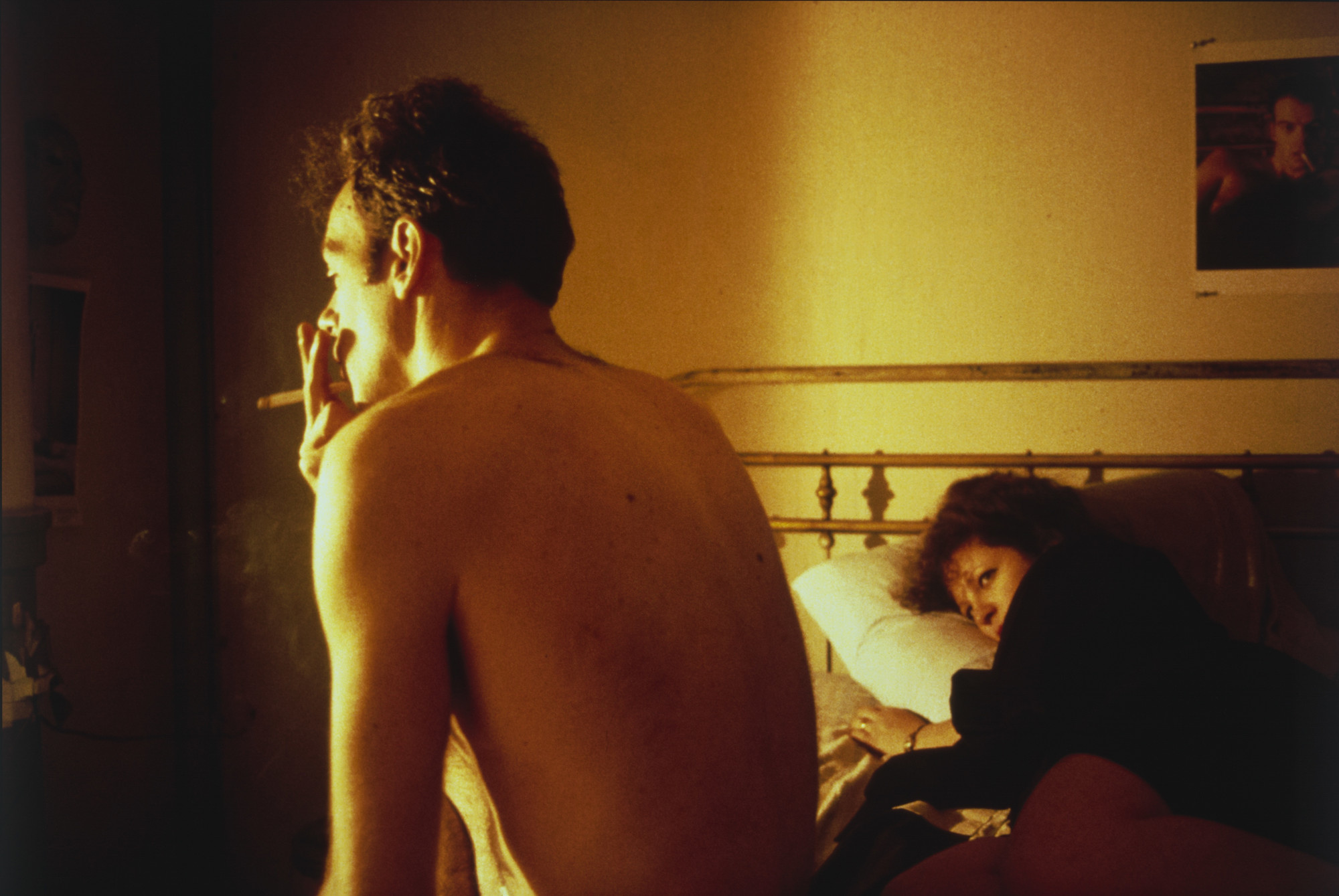
Nan Goldin (American, born 1953). Nan and Brian in Bed, New York City. 1983. Silver dye bleach print, printed 2006, 15 1/2 × 23 3/16" (39.4 × 58.9 cm). The Museum of Modern Art, New York. Acquired through the generosity of Jon L. Stryker. © 2016 Nan Goldin
"Nan and Brian in Bed, New York City," an example
of Nan Goldin's work in The Ballad of Sexual Dependency.
*Amy Horst’s costume inspiration pierces me: Nan Goldin’s The Ballad of Sexual Dependency. She showed me pictures before today, and I’ve seen some floating around the MCT office. It’s been driving me crazy why they looked so familiar. Of course it’s during her design presentation to everyone gathered that it clicks. I caught Goldin’s work at the Milwaukee Art Museum a few years ago when it was on exhibition with other photography. I remember what I felt watching it. Discomfort. Openness. Nakedness. Weariness. Loneliness. Nah—desolation. Intimacy. There’s that word again.

*This is such a song for the rarely celebrated.

*Brandon Kirkham, our scenic designer, says Frankie’s apartment in Hell’s Kitchen is “gritty.” My most recent contact with Hell’s Kitchen was a date with a Manhattan (the drink, to be clear) and back-to-back episodes of Daredevil on Netflix. Same setting, a particular pocket of New York City. Just some decades apart, at least as the Marvel juggernaut has framed it now on film and television. What does the script say about the population of New York City again? I grin to think of a few superheroes running around out there somewhere. Most everybody else is slogging along. Frankie? A slogger.

*Johnny keeps a dictionary in his locker at work. I suddenly want to look up the word “intimacy” for how the dictionary frames that word we use all the time. How do you know when you feel true intimacy? How can one ever know?—all you can do is assure another you feel it. But do they? What’s true assurance? All we really have is our own construct of another based on collected evidence. All we really have is their word that our construct of ourselves is somehow discernible and pleasing to them. Gosh, that’s a rabbit hole. I’m remembering that photography.

*On a break, I find myself trying to remember the productions on which Todd and I have worked together as actors before. Turns out three out of the four were Shakespeare. The first? THE MERRY WIVES OF WINDSOR. I laugh out loud: MERRY WIVES is actually mentioned in FRANKIE AND JOHNNY.

*Our assistant stage manager’s name is Jena. Jena’s got a giant job ahead of her. I don’t envy her, and I am grateful already for the help I know she’s going to give along with Judy, our stage manager. Funny. I instinctively trust her in part because her name’s Jena, not just because of the position she holds—because my college roommate’s name was Jenna, and she was fantastic. Associations, connections, coincidences bubbling up… Johnny’s big into that kind of thing. I’ve got a few of my own happening here.


More notes to come, friends. In the meantime, a lovely September to you. I have to head to the rehearsal hall.

Milwaukee Chamber Theatre's production of FRANKIE AND JOHNNY IN THE CLAIR DE LUNE, by Terrence McNally, runs Sept. 20 to Oct. 15 at the Broadway Theatre Center's Studio Theatre. Tickets are on sale now at 414.291.7800, in person at 158 N. Broadway or our online box office. Visit milwaukeechambertheatre.com for more details.

Tuesday, July 25, 2017

Violence by Design: An Interview with Fight Director Christopher Elst

by Marcella Kearns

A few summers ago, I saw a sequence of torture and murder onstage that horrified me in all the right ways—simply, it looked real. Fully immersed in the tension of the moment, I forgot for a moment where I was. In hindsight, however, I realized I hadn’t for an instant worried about the actors both perpetrating and undergoing the crime not ten feet from me in real time. Why?

Christopher Elst.

Elst, fight director for MCT’s production of DEATHTRAP, has a gift for making an audience squirm with the kind of intricate physical storytelling that follows when conflict between characters escalates beyond words alone. Since seeing his work for the first time those summers ago, I’ve been insatiably curious about his process and his own story. Recently, even as he wrapped Theater RED’s latest production (Elst and spouse Marcee Doherty-Elst are the company’s producing directors), he graciously granted a request for an interview.

Marcella Kearns: What originally drew you to undertaking the study of violence design (stage combat)? What continues to captivate you about this aspect of the theatre?

Christopher Elst: I started in high school when I heard about the “fencing” program for the high school Madrigal Dinner in Kenosha. I had always had an eye for swords and martial arts and thought this might be a way to start learning more. I was “captain” of the team in my senior year, but it was really more of an acting troupe than anything. I began to assist the teachers in my first year out of high school, and then began teaching it myself shortly thereafter. I joined the SAFD (Society of American Fight Directors), at the urging of Jamie Cheatham, in 2006 and have pursued stage combat as a profession ever since.

MK: Tell us about your personal process in building physical fights onstage. How do you approach a script and your work in the rehearsal hall?

CE: Theatrical violence incorporates the most important aspects of theatrical performance: objectives and commitment at the very highest stakes, physical communication and cooperation between actors, and a dual awareness at both the character and actor levels. For me, stage combat informs all of my work as an actor.

I consider stage combat to be a modern martial art, focused on storytelling, rather than defense, in the same way that many Eastern disciplines teach that violence and destruction are set aside in favor of aesthetic creation. A master becomes an artist, as the understanding of violence reminds one of their human nature—the earth, the id, the beast, etc.—but channeling that directionless passion are the creative and rational drives. As artists in the theatre, the consummation of all arts, we have the ability and responsibility to bring this violence as realistically to bear as we are able in order to confront and discuss, and perhaps to change, the way in which we accept and cope with our natural tendency toward violence.

To that end, it is essential that we as fight directors give our actors the tools required to tell these stories. By necessity, we begin to help with precautions against harm; beyond the obvious preservation of the body, if the actor must hesitate because of a safety concern, then we have hindered the story by whatever fraction that hesitation costs. Contrarily, when we instill in actors the knowledge and practice to free them of the constraint of fear, we not only allow that particular scene to come alive, but we bring the actors to a greater state of awareness and commitment, which can only serve them in all aspects of performance.

The responsibility is colossal for fight directors, as with any teachers, to keep this always in mind. We must understand fear, violence, and all of the darkest parts of our humanity in order to create compelling art, but we must be in command of those forces, and teach others to be in command of them, if that art is to be of value.

Elst directed the fight scenes in Theater RED's swashbuckling BONNY ANNE BONNY.
(L, Zach Thomas Woods; R, Alicia Rice. Photo: Traveling Lemur Productions)

MK: What have you found is the most challenging part of staging fights with actors who have very little experience with combat? What’s challenging, on the other hand, about working with actors who are very experienced?

CE: Classical acting training once mandated that all actors be trained in stage combat, but it’s rare to run across someone with more than cursory knowledge today, which is surprising when one considers all of the popular media that features violence. Working with an actor unfamiliar mostly poses challenges in getting the appropriate commitment level; they are usually either too timid or too eager. I am fond of saying, “Keep your method acting out of my stage combat, please.”

Contrarily, with actors accustomed to the work, including me, the trick is to remind them of the dangers the characters face and not to be too complacent in the responses. Also, veteran stage combatants can cling to bad habits, or make a character seem facile with a weapon, when the character should not be. Being too comfortable with stage violence can be detrimental to the story, even if safety is more assured.

MK: There are several weapons revealed as part of the setting of DEATHTRAP. If you had your pick, which of those would be most exciting to you to use in a fight and why?

CE: I have to say, I was drawn to the work by swords, and I’m still fascinated by them, even with my facility in their use. There’s a reason other weapons just never found their way as strongly into the canon of theatrical violence, and indeed, history. There have always been swords. Their elegance and effectiveness are unsurpassed.

MK: Along the same lines, what do you enjoy most about DEATHTRAP, both as an artist working on the team and as one who gets to see it from the house?

CE: Long before I considered the theatre as an occupation, I had seen the film version of DEATHTRAP. I love the blend of dark humor and true thrills, and I hope to bring the actors to a place where they can startle even me with this production.

MK: If it’s possible to answer this without spoilers: what do you foresee may be the most challenging thing for you to accomplish (and/or the actors to execute… no pun intended…) on DEATHTRAP?

CE: Theatrical violence is no different than a magic trick. The challenge here is that we never know which effect is meant to be real and which is a character fooling another character and the audience. We want to create that duplicity without belying the truth of each moment. That will take some real focus, and I think we have a great team to make it happen.

MK: Do you have any “dream plays” to choreograph?

CE: I think I’d like to have a chance at THE THREE MUSKETEERS or something in that vein. BONNY ANNE BONNY (with Theater RED) was the closest I’ve come, and we did a bang-up job if I say so myself, but those old swashbuckling epics were the beacon to me in my youth, and I’d like to see what I can do when realism is no limit.

Elst’s innovation seems to have no limit. Join us at MCT for DEATHTRAP — with him in charge of the fights, we can guarantee the thrills.

DEATHTRAP opens August 10 and runs through August 27. Tickets can be purchased at 414.291.7800 or online.


Monday, November 7, 2016

Heroes in Search of a Code

by Deanie Vallone

Think of the word “hero” and what is conjured? Marvel superheroes? Historical movers and shakers? Fanciful characters from literary epics? Regardless, heroism usually requires one to shed the weight of humanity, excel above and beyond the ordinary citizen to make a lasting, positive impact on the world.

The characters in Kenneth Lonergan’s play, LOBBY HERO, do nothing of the sort. And yet, as the story unfolds, these four characters — an ensemble, each protagonists in their own right — find themselves touching the shiny veneer of the word “hero” and grappling with its meanings and implications.

Chris Klopatek plays Jeff in MCT's production
of LOBBY HERO. Photo: John Neinhuis. 
When we open on the titular character of the play — lobby security guard, Jeff, a wise-cracking man-child with no sense of decorum or filter — it is difficult to see how he could be labeled a hero, even if only a “lobby hero.” With the appearance of the play’s three other characters — by-the-books supervisor, William; on-the-rise cop, Bill; and his on-probation rookie, Dawn — the question of heroism becomes inextricably linked with modes of power and performance. 

Though there is clearly a hierarchy, in which Jeff occupies the bottom rung, and the cops see the security guards as “doormen,” all four characters, by the virtue of their work as protectors, grapple with the complexities of power, authority, and the law. But Lonergan’s skill with LOBBY HERO is extrapolating the reality of their humanness, the painful limitations that restrict these potential heroes not necessarily physically, but morally and ethically.

Morality is understanding the distinction between right and wrong, while ethics is the philosophy of how that morality shapes and guides individual and group behavior. While some critics have called LOBBY HERO a melodrama — what with its murder investigation and sexual politics — Lonergan says the play is “a bit like a fable, a tangled morality play.”[1] Like his previous plays, THIS IS OUR YOUTH (1996) and THE WAVERLEY GALLERY (2000), he infuses LOBBY HERO with naturalism, but this play distinguishes itself with “something more theatrical, […] a bit more heightened.”[2] It is clear from the beginning that all four characters are playing at heroism—Bill as the “Supercop;” Dawn, whose brash attack on a civilian is just one act of many meant to prove her worth in the police force; William, struggling to run a smooth ship, despite personal and professional obstacles; and Jeff, who, despite his goofball personality, is sincere in his desire to be a better version of himself. 

This concept of performance is key because when faced head-on with issues of morality and ethics, these characters become embroiled in “a restless search for a new moral code in response to the failure of the old codes.”[3] In searching for this new moral code, they must be the ones to define it.

Lonergan’s quartet occupies a gray area — in their struggle for goodness, they make plenty of mistakes. At odds with themselves, these are people who see and appreciate heroism, but lack the ability to achieve it. Jeff encapsulates this perfectly when recalling his Naval officer father’s own heroic actions. “It’s actually a really amazing story,” Jeff begins. After listening to how Jeff’s father saved the lives of twenty-three of his fellow Naval men, William remarks, “That’s very impressive,” to which Jeff replies, “Yeah: I know it is impressive.” With a childhood marked by his father’s re-performing of heroism through the act of storytelling, Jeff’s own retelling of the event is imbibed with awe and a deep-seated animosity for a heroism he longs for but struggles to emulate.

Lonergan’s characters tap into the “theatricality” of heroism, if not the actuality of it. For a play about murder, blackmail, and sexual harassment, LOBBY HERO lacks a police drama’s heightened action. Instead, the play encloses the characters in an environmental crucible — a high-rise lobby in Manhattan — where they perform heroism through the myth-building act of conversation and storytelling. We rarely see physical action being taken; instead, we listen to the characters attempt to shape and define their personal narratives, and thus themselves, through the versions of the stories they tell.

"I was interested in people’s personal behavior versus what they expect of themselves,” Lonergan says of this play.[4] This conflict of interior and exterior selves, of expectation and reality, is key to the characters’ interactions with each other. Dawn, for example, plays tough around other cops — ”You make them respect you” — but her partner still sees her as “a little girl wearin’ a police uniform.” William and Jeff argue about responsibility to one’s family while Dawn argues for lawfulness. “[I]t’s still your responsibility to tell the truth and obey the law. You can’t just make it up when there’s some part of it that you don’t like,” she says, to which Jeff counters, “But somebody made up the law, didn’t they? Some people made up the law, a bunch of people like you and me literally sat down and wrote it up[...]” Jeff’s statement notes the inherent myth-building within the old moral codes, inherently flawed because they were created by people. 

Lonergan has mentioned that many characters in his plays are based on real people. The reality of humanness at work here remains central to the characters’ moral and ethical struggle to define themselves and the world around them. Unable to shake their humanity, their quest for heroism is weighed down with real flaws, moral quandaries, biases, and fears.

The world of LOBBY HERO is morally muddy. It’s not surprising then that Lonergan’s characters have difficulty navigating this quagmire, and don’t always come out with the correct answer. The play asks a lot of tough questions of its “heroes” and audiences: What does it mean if you’re doing the wrong thing for the right reasons? What if doing the right thing means hurting or betraying someone? When are we allowed to decide if the law is right or wrong? Are you still a hero if no else else thinks you are or if you’re maligned for your actions? 

While the play doesn’t easily answer all of the questions, heroism, it seems to say, does not come as simply as donning a cape.


[1]    Kushner, Rachel. “Interview with Kenneth Lonergan,” BOMB Magazine, 2001.
[2]    Ibid.
[3]    Siegel, Ed. “You can count on 'Lobby Hero' for craft, cleverness,” Boston Globe, 2001.
[4]    Renner, Pamela. “Talking Shop (Which Takes In the World),” New York Times, 2001. 

Monday, August 29, 2016

Taking a Trip to LOVELY SUNDAY's Real Creve Coeur Lake

by Logan Peaslee, MCT marketing and development assistant

Although mentioned frequently throughout Tennessee Williams' A LOVELY SUNDAY FOR CREVE COEUR and even used as the title, Creve Coeur is never actually seen by audience members; the play's action takes place entirely in the home of its protagonist Dorothea. But the destination’s history, current status, and name itself are too interesting to leave offstage.

Photo: St. Louis Post-Dispatch
Creve Coeur Lake, which is the largest natural lake in Missouri (320 acres!), has a history of hosting boating events. In the 1880s, the lake hosted the Mississippi Valley Regatta and the Creve Coeur Regatta. Perhaps most interestingly, the rowing competition for the 1904 Summer Olympics was held at Creve Coeur Lake, with the United States earning five gold medals for rowing that year. By the 1930s, when Williams' play takes place, the lake had become a popular picnic spot for residents of St. Louis. In A LOVELY SUNDAY FOR CREVE COEUR, several of the characters are preparing for one such picnic.

Creve Coeur’s interesting history did not end with the 1904 Summer Olympics. As recently as June of 2015, the park found itself in the news. A rising in the Missouri River pushed Creve Coeur Lake out of its banks and flooded the entire park. With the picnic areas, trails, and parking lots completely under water, there was likely little prospect of a lovely Sunday at Creve Coeur. Fortunately, the park's facilities had been designed to withstand flooding after a similarly large flood two decades prior (the Great Flood of 1993) destroyed the park’s amenities, and the park has since recovered

The name of the lake and park is French, and it means “broken heart” or "heartbreak." Legend has it that a Native American princess fell in love with a French fur trapper when the area was being settled. When her love was not returned, she jumped from a ledge overlooking the lake. From then on, the French settlers referred to the lake as broken heart lake, Creve Coeur Lake. 

Boating is a part of Creve Coeur Lake's history
as well as its present. Photo: Wikimedia Commons.
Since A LOVELY SUNDAY FOR CREVE COEUR explores the concept of heartbreak, it is fitting that Tennessee Williams included this particular lake in his play. The meaning of “creve coeur” also raises an evocative question: why a location never even visited in the play is worthy of the title.

In 1945, Creve Coeur Lake and the area surrounding it became a county park. Visiting the park today, you can return to the lake’s boating roots and sail, as well as canoe, kayak, and paddleboard. The park has Missouri’s first and only treetop adventure course. At fifty feet in the air, the course offers zip lines, swings, and an obstacle course. For those who prefer dry land and who are afraid of heights, Creve Coeur Park has gorgeous hiking and biking trails. Aside from the many exciting activities mentioned, the park remains a popular picnic spot. So if you’re ever in the St. Louis area and want to have a LOVELY SUNDAY afternoon, head to Creve Coeur Park!


References

Barr, Diana. “Missouri Declares State of Emergency Amid Flooding.” St. Louis Business Journal. St. Louis Business Journal, 19 June 2015. Web. 24 Aug. 2016.

“Contests at the Oars.” Archives. The New York Times, n.d. Web. 24 Aug. 2016.

“Creve Coeur.” St. Louis County. St. Louis County Government, n.d. Web. 24 Aug. 2016.

“Creve Coeur Lake Memorial Park.” St. Louis Audubon Society. Wild Bird Center of South County, n.d. Web. 24 Aug. 2016.

Dalton, Gloria. “History.” The Heart of Community and Commerce. City of Creve Coeur, n.d. Web. 24 Aug. 2016

“History of Creve Coeur.” St. Louis County. St. Louis County Government, n.d. Web. 24 Aug. 2016.

“Sporting Affairs.” Archives. Chicago Tribune, n.d. Web. 24 Aug. 2016.


Sullivan, James. Spalding’s Official Athletic Almanac for 1905. New York, NY: The American Publishing Company, 1905.